Mysterious- Look, See, Pray

Why take a photograph? Using flowers and plants as an example, let’s answer that “why” question.

Before cameras were invented, naturalists illustrated their work with carefully crafted drawings and paintings. Many of these were exquisite, detailed and accurately coloured.

Then came film and modern lenses: almost perfect replicas of the subject, unadulterated by any human mis-perceptions. Such photos are a stunningly accurate copy, which is fine if you are illustrating a textbook. Yet if photography is ART, arguably some different qualities are needed.

The “why” comes into play. What drew the eye to the subject? Is it the shape, the form, the colour, the contrast, the light? Perhaps the scent? Pictures can’t help with that last one!

Art interprets as well as records. By controlling the composition, the lighting, even the lens used, the photographer selects the desired qualities of the subject and then attempts to succeed in capturing a satisfying representation that pleases the eye, mind, and emotions.

Some would say the photo “tells a story” or conveys something important to communicate to the viewer.

What about this picture? It’s a dark-orange sunflower called “Red Sun” and I spotted it one morning just as it was starting to unfurl its petals. It looked spiky and soft at the same time! The gentle light softened the leaf colour, and the unfocused background made the dark petals jag out like a crown of spears against the pale greens and blues.

Tiny, delicate hairs add texture and finer detail as the eye explores.

A few hours, a day later, and the “normal” flower shape would be established and probably make this sunflower more ordinary.

For me, the shape matters: and the harmonious spread of pastel colours behind the dark, stark petals makes me want to look again; it holds my interest, and captures a specific moment in time for this particular plant.

I have to say that I find the concept of random existence and evolution unsatisfying. The qualifying word there is “random.” Faith and science sometimes collide- and sometimes they mutually enrich. All too often scientists and theologians have butted heads like angry goats! Usually, because theologians don’t understand science AND scientists don’t understand theology. (Both disciplines are complex and multi-faceted, and require a lifetime of study in order to reach the point of realising we only scratch the surface of knowledge and meaning. That’s the point at which a bit of humility and mutual respect makes the conversation fruitful.)

Faith asks questions about mystery and addresses those mysteries via the self-revelation of God, which weaves through all things like a glorious golden thread.

Meditation on a photograph, an interpretation of reality, allows the mind and spirit of a human to ponder beauty; and perhaps discern the fingerprint of the Artist. Add to that an examination of the life, nature, and resurrection of Jesus Christ and an Eternal Light shines through into our own present reality.

Sounds a bit grand, rather high-faluting, and possibly ambitious! But is it so unlikely that a Creator leaves a “signature” on the supreme Art of existence? Only one way to find out- give it a try!

Viennese Whirl? Look, See, Pray

The iconic Ferris Wheel in Vienna should have been demolished in 1916- but the Empire couldn’t afford it. Since then it has become a famous landmark, and appeared in the film “The Third Man” and also in a Bond film, “The Living Daylights.”

A local saying is that if you ride the wheel and see the whole of Vienna from there, you will love the city forever.

On our visit to Vienna, we didn’t have time to queue for tickets, so we only saw the Ferris Wheel from the tour bus. The effect worked at least partially- I’d love to go back and spend more time in Vienna- a city of beautiful architecture and great culture.

But apart from the classic engineering and the stunning view, the wheel has little value. It goes round, the cars rise, crest, and descend- and that’s it.

Is that how most of us see life? A treadmill with a good view?

Repetitive behaviour is part of life. We sleep, wake, eat, work, eat, and sleep. Assuming we are fortunate enough to get more than meal a day.

A Ferris wheel is essentially an entertainment. Life is a journey with purpose- or should be. Western society is in danger of being entertained to death! There must be more to life than this.

I am reminded of the experience of Zaccheus in Luke 19:1-10. He was a tax officer of dubious ethics- the basic way of tax collecting for the Roman provinces was to raise whatever the Governor told you to collect: and anything else you could extort was yours to keep. To say they were unpopular is a major understatement.

Yet Zaccheus realised his life was a failure. Having heard that Jesus was nearby, Zaccheus (a short bloke) climbed into a tree to listen. Imagine his shock when Jesus (against all custom and religious purity) invited himself to Zac’s place for a meal and chat! Everyone else was horrified- didn’t Jesus realise this was a SINNER, traitor, collaborator, tax collector!!!

Of course Jesus did. Upshot- Jesus was unpopular with the self-righteous snobs, Zac’s life was turned around, and the people who’d been ripped off were generously compensated. The Kingdom of God moved in, and turned the world upside down.

Jesus said that He was here to do what the Heavenly Father required. His call to Zaccheus (and us today) is to follow that way- to walk alongside Jesus, and do what God wants done.

It’s riskier, but it sure beats a Ferris wheel ride!

Up More Steps? Look, See, Pray

In the gardens of a National Trust property not far from home is this stairway heading up to a Japanese-style wooden framework atop a small mound.

Depending on how tired the visitor is at this point, you can climb the steps to get a broader view of the lovely garden. I wonder what percentage of visitors make this climb? Certainly, on the day of my visit, the majority passed by the opportunity to climb and see more of the carefully planned layout.

“People only see what they are prepared to see,” observed Ralph Waldo Emerson. That is a very perceptive comment! It helps explain why some people find conspiracy theories addictive; and why the followers of certain types of politician find it impossible to criticise their chosen “guru”.

Another perspective on this: the sarcastic description of people of very fixed opinions prejudices- “Don’t confuse me with facts, my mind is made up.”

We’ve all met (and knocked heads with) such people. It’s very trying!

As a pastor for over 30 years, I’ve come across Christians with a vision shortfall. Their faith and expectations reach so far… but ask them to climb up and look beyond, and their horror is evident! To be honest, there have been moments when I have suffered similar limitations of vision… and I have missed blessings and fruitfulness as a result. We all have “comfort zones” – but Jesus took delight in challenging the crowds (and certain named individuals) to raise their eyes to see a bigger vision. “Peter, do you want to be a fisherman all your life? Leave it all behind, and follow Me!” (See Luke 5 for the whole story.)

An interesting thing about photography: changing your “standing point” and eye-level does wonderful things to your pictures. Yet probably 80% of photos are taken at standing eye-level. Moving to one side, or going to knee-high, or climbing a ladder or hill can turn “nice snaps” into dynamic art.

Lord, what am I truly prepared to see? How does that limit the vision You want me to be part of? How much should I move or climb to see YOUR vision? Please help me grasp the courage to keep climbing- and give me the curiosity to want to climb some more steps!

Not Too Bad, Really- Look, See, Pray

I’m proud of good old-fashioned English understatement… our ability to face both disaster or triumph with equanimity- so, when asked “How are you? How’s things?” the classic response is “Not too bad, really. Things could be worse.”

On a day where the wind blew straight through you and the crackle of ice under foot as the snow froze could be heard, this golden retriever was as happy as Larry. Snow was sent for playtime not for being miserable. Dogs are probably hardier than we are! Every single human being was heading for the cafe or back to the car. But I reckon at least some of those dog owners would have said “Things could be worse” even as the Arctic clouds dropped another load of the white stuff on their heads.

This phlegmatic Britishness is quite admirable in its own way. In times of national crisis we have often faced horrible things with a smile provided there’s still a cup of tea on the table. Is that enough? It’s a pretty “low bar” to say things could be worse.

As people of faith, we surely have a better basis for confidence. Here is a short list!

  1. God is Sovereign, so we can trust in the ultimate outcome.
  2. Jesus has promised to be beside us in life and death.
  3. The Lord often finds human “plans” amusingly futile.
  4. Our hope in Christ is eternal and certain.
  5. The Love we have received can be passed on to benefit others.

These verses (below) are a Bible basis for our positivity:

  1. Exodus 20 v2-3
  2. Matthew 28 v20
  3. Psalm 2 v1-4
  4. Hebrews 6 v19
  5. 1 Peter 4 v10

These are just a taste of the sweetness of Christian hope. Why not search out some more examples of the BETTER way of faith?

(Also published on reflectionary.org )

Splintered Light- Look, See, Pray

“Stand with the Sun behind you and you’ll get a nice photograph.” Safe advice, often given to new photographers… I think that film manufacturers wrote something similar in with the rolls of film (I’m assuming some of you remember “film” for prints or slides). It was not cheap, and developing costs for prints were quite high. In the Era B.D. (Before Digital) poor hobbyists had to work hard, and not take too many chances. Playing safe saved money! Quite often the results were predictable, and frankly often boring.

Taking a photo like the one above was a big “no-no”. Risky! Measuring the light (or guessing the exposure) was an arcane exercise. Although, from the 1970s onwards technology was progressing and in-camera light meters reduced the odds of failure.

Experience gained (often from making mistakes) helped; and whole books were penned about “correct exposure” and effective composition. A steep learning curve and an expensive hobby!

Today’s photo is of frosted grasses and weeds, just beginning to thaw in early morning sunshine. The sunlight was at 450 towards the lens, backlighting the droplets and splintering the light. I used a low crouching position to shield the lens from direct sunlight, preventing flare and sunspots. Clever stuff! (I won’t spoil the effect by telling you how many other attempts of scenes like this were failures.)

Taking risks and seeking out “learning moments” will shape us into better photographers. Capturing light and interpreting it is the very heart of photography. Funnily enough, the principle is very similar to good theology! Looking at the Light of revelation, and trying understand and apply it to life- what we know about God, and what difference it makes.

We can “play safe” with faith, carefully colouring in between the lines and avoiding tricky questions. Predictable, satisfying, unobjectionable. We can learn “our” party line, listen to “safe” speakers, and hide safely in the crowd. For a while at least, that can be good enough.

But when BIG questions come up, when tragedy rocks our foundations, when moral and theological issues impact “our” small world, we have to go looking for insights from a fresh angle. We look into the Light, squinting and blinking, and discover that splintered Light illuminates in a newly beautiful way. In taking a risk, we are stretching out in our faith- and always seeking to draw closer to God Himself. The essential “Good News” (the Light itself) is unchanged; but moving our viewpoint helps us see MORE.

Perhaps learning more about the Bible itself from scholars and mature believers; or opening ourselves to “Go on going on being filled with the Spirit” (Ephesians 5 v18). The great Reformers and Puritans had a saying “The Lord has yet more Light to break forth from His Word.” When we stop learning, we stop growing.

Jesus took his Twelve disciples on a three-year journey of discovery. They learned about God, about the Scriptures, about themselves- and a whole load of experiences and puzzles that stretched their minds and spirits until they became more and more like Jesus. They took risks, faced impossible odds, saw God at work in unthinkable ways: they wept at the crucifixion and were astounded at Resurrection. They then received the Holy Spirit at Pentecost… and their story journeys through the centuries to join our own.

Faith and photography are simply “learning to see Light.” Then the Light reveals Life, and drives out the darkness. “Faith” and “photo” can both be spelled R-I-S-K.

(c) 2024, Richard Starling. First posted on reflectionary.org on this date.

Writing with Light- Look, See, Pray

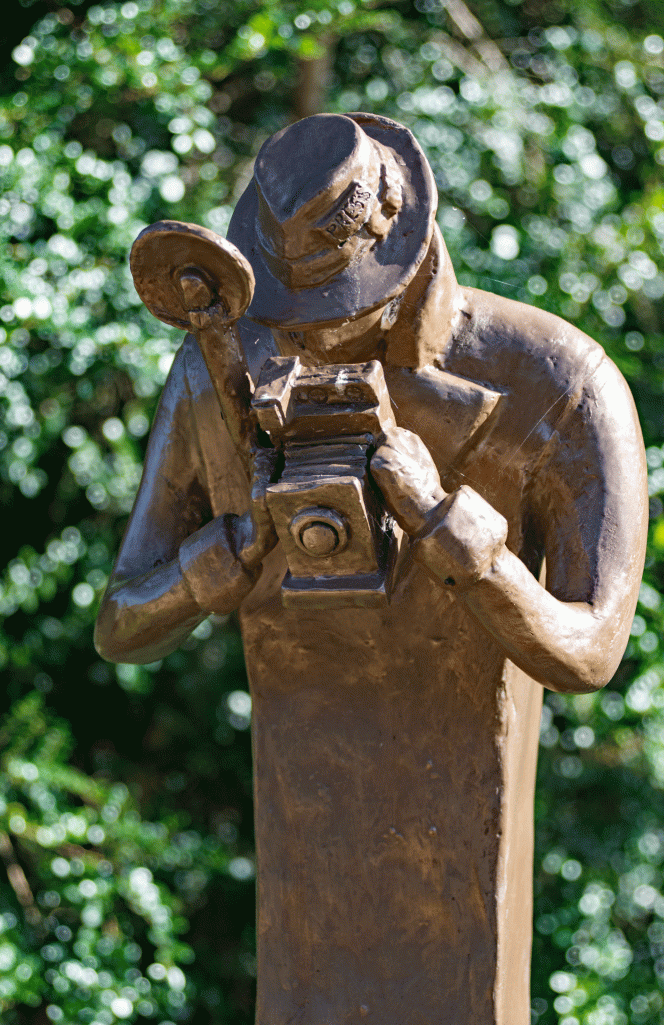
Enshrined in bronze… meet the Press. How astonished a Press photographer from the Fifties would be if they were given a modern camera. If that new camera were digital instead of film, I don’t think they’d believe it was real.

Old but beautifully machined; accurate shutters, decent lenses, lovely leather bellows for focussing. And that flash unit! Explosive combustion of glass bulbs- one blast of light which might singe your eyebrows. Then having taken a photo on light-sensitive plates or sheets of film, off to a lab for chemical processing and hard-won wizardry to produce expensive prints or glass slides.

Modern technology and engineering has changed the process of photography beyond measure.

Yet the goal is the same: to capture the “decisive moment” of an action or object, recording it for posterity. Photography aids our memories, records moments of history or newsworthy events; it preserves beauty and can tell a powerful story of life events and relationships.

OR the photographer may cut off the head or feet of the subject, blur or shake the image, or just take mind-numbingly boring pictures that no-one else wants to see! (Taking a photo of a statue of a paparazzi taking a photo, for example…)

Photo = light, graphy = writing… Writing with light. Isn’t it a shame that photography hadn’t been invented when God started “writing with Light” at the incarnation of Jesus, the Light of the world!

To see pictures of Mary & Joseph, scruffy shepherds, assorted Wise Men, and a sulky Herod? To record forever the angels who told of the Blessed Child, and then gathered the legions of Heaven to rejoice over Bethlehem… and, of course, the baby pictures of Jesus at birth, one day old, a week, a month. If only.

If Jerusalem had newspapers and a horde of reporters… has God missed a trick? If Jesus were born today, the news would be all round the globe as soon as the broadband was switched on!

But since the media frenzy has the attention span of a gnat, the story would be dumped by Tuesday. Instead, Almighty God sent a messenger with Good News and a promise. Luke 2:37 says “For no word from God will ever fail.”

Two thousand years later, the story is still current. “In the beginning was the Word… and the Word became flesh, and dwelt among us” is how John’s Gospel begins.

No photos- but a Living Word.

Distortion- Look, See, Pray

I’ve just had new specs- and the process worked perfectly. There was one time when one lens was convex and the other concave: trust me, the world looked seriously odd! Those glasses had to be remade properly.

You may be thinking I took this photo of London’s Shard and River Thames through wrong glasses. It’s strange and distorted, even disturbing.

I did that on purpose. Photography is fun- and digital files can be edited easily with computers to make striking images out of ordinary subjects. Note: I said “striking” images, not necessarily ones you’d want to hang in the hall.

Distortion happens in many ways- some deliberate, some by accident, others by incompetence. We all think we see the world “the right way” but our ideal world is shaped by many influences in our background, education and experiences. Others see things very differently, which is why people sometimes clash.

Art and literature distort on purpose. Think Picasso, or Dali… or the gentler fictional existence of Bertie Wooster. Young Bertie represents an upper-class drone in English society of the Edwardian era. An amiable English gentleman and one of the “idle rich”, Bertie appears alongside his valet, Jeeves, whose intelligence manages to save Bertie or one of his friends from numerous awkward situations. Bertie Wooster and Jeeves have been described as “one of the great comic double-acts of all time”. (Sam Leith, in the Telegraph, 2007)

I’d like a Jeeves.

Someone to sort out any problems, make my path smooth, and generally allow me to avoid all responsibility. Sounds wonderful. I think so, anyway…

It would be a distortion of real life. I suspect it wouldn’t work, but it isn’t unknown for humans to look for a “Jeeves solution” through religion. Christianity is far from immune from this! When we view Jesus as a personal servant or genie whose duty is to fulfil OUR wishes, we’re entering the realm of distortion of truth and faith.

Jesus or Jeeves.

Even a swift read through the Gospels should help us see that the Jesus who invited people to “Follow Me” and even “Take up your cross and follow me” is not your best bet for a deity to make life easy and free of all problems.

Have a think about the last few times you prayed. How many of those requests/demands could have been finished “in the name of Jeeves, Amen!”

Jeeves would be my all-powerful servant.

Jesus is my Lord, my Saviour, my Life-Giver, my Hope- and I serve Him.

One of those two sentences is a grave distortion of reality. We need to think carefully before we start treating God as a bit of a convenience store, open all hours for our whims.

Distortion can be deadly dangerous!

Truth… the whole truth – Look, See, Pray

Great pic, isn’t it? Eagle Owl, Dartmoor, near Princetown. All my own work: could start a rush of twitchers heading for Devon!

Except this is a way of telling truth to mislead. It is an Eagle Owl, I did take the photo. So far, so good. It is Dartmoor in the snow- I took the photo. All true. So what’s the problem?

I combined the two pictures so the owl had a more “natural-looking” backdrop. I haven’t lied, but I wasn’t 100% accurate.

My intention matters. If I have just melded two photos for a better picture, that’s OK. Were I to present myself as a wildlife whizz, discovering Eagle Owls in Devon, then perhaps selling the image to a news agency in exchange for fame and fortune, that is unethical and dishonest. And WRONG.

“The camera never lies” says the old proverb. But it may mislead, even present corrupted truth (in other words, a LIE). This is a huge problem in journalism, advertising, politics… “Deep fake” pictures are created and used to destroy the victim’s reputation, or as the lever for blackmail. Bits of truth selected deliberately, then mixed into untruth. A complete rejection of integrity.

Unless we are careful to act with integrity, there is even a danger that “picking bits” of the Bible then jamming them together will mislead or misdirect people who are seeking God. This coming Sunday, I’m preaching at our church. I have a heavy responsibility to tell the truth truthfully: or I risk putting words into God’s mouth, or persuading people into misunderstanding. A stern warning from the New Testament: “Not many of you should become teachers, my fellow believers, because you know that we who teach will be judged more strictly. – James 3 v1

James points out the risk that teachers and preachers take on. Matthew’s Gospel records words from Jesus about the required heart-attitude, the integrity, of those called to serve through leadership and preaching. It must be real, and honest, and true- not a crafty construction of bits of truth. If I cannot preach out of humility and integrity, I should not preach at all.

“Everything they do is for show. On their arms they wear extra wide prayer boxes with Scripture verses inside, and they wear robes with extra long tassels. And they love to sit at the head table at banquets and in the seats of honour in the synagogues. They love to receive respectful greetings as they walk in the marketplaces, and to be called ‘Rabbi.’ Don’t let anyone call you ‘Rabbi,’ for you have only one teacher, and all of you are equal as brothers and sisters. And don’t address anyone here on earth as ‘Father,’ for only God in heaven is your Father. And don’t let anyone call you ‘Teacher,’ for you have only one teacher, the Messiah. The greatest among you must be a servant. But those who exalt themselves will be humbled, and those who humble themselves will be exalted.” – Matthew 23 v5-12

Please pray for me- and any other preachers and teachers you know.

Elephants and a Bridge- Look, See, Pray

What am I photographing? Is it a famous Dartmoor bridge? Perhaps it’s the River Dart. Yes …. but… No. It’s the Sun.

“Eh?” I hear. “But the sun isn’t in the picture!”

Correct- but the Sun is too bright, too big, too awesome. No earth-bound camera can cope with that challenge. All we can do is record the effect of the Sun, showing how the light changes our perception of the world. Reflected by the stone and water inside the arch, light glows out. We just KNOW that if we looked through the arch, we’d see the sun (or be dazzled by it, anyway!).

When we say “What is God like?” we’re doing theology. Our problem is trying to explain and describe the gloriously indescribable- we lack the words to speak, and the mindpower to comprehend. Our best insight comes from the self-revelation of God’s true essence in the person of Jesus Christ. (Since it’s Lent, it is a great time to think about the life, death and resurrection of Jesus.)

Imagine describing an elephant to someone who has never seen one. Ask two friends to draw a picture, one starting from above, and the second person working from the feet upwards.

The picture might look like the one below: and it’s a brain teaser! How many legs does an elephant have? Of course you know… but the drawing may make you rather confused.

Now, the conclusion of Christian theologians is that Jesus is the Son of God, the second Person of the Holy Trinity, the Three-in-One. How will you explain the Trinity? Tricky… our best efforts are incomplete. How do you “explain” Jesus as both human and divine? With difficulty. If you start from the top, the God-ness of Jesus, you will understand quite a lot. If you start from below, the human-ness of Jesus you will understand a whole lot more.

But the picture isn’t perfect, or without mystery. It’s like the “legs of an elephant” picture… and it’s the best we can do. So if someone understands a bit differently, perhaps it’s just because they’re seeing from a different angle. We can still be friends, and still follow the path of Jesus.

Jesus said “I am the Light of the world.” All our theology, and all our debates, are trying to describe the effect of Light in a world in shadow. Our God is too big, too strong and too Mighty to capture in our “brain-cam.”

He is LIGHT. In a dark time in a suffering world, it’s the Light that keeps us alive, still hoping, still trusting, May the Light shine on you! 

Early one morning… Look, See, Pray

Woke up too early this morning! Made coffee, decided against vacuuming the carpet (too noisy, might wake up Juliet and the neighbours) so switched on the computer to carry on the sorting of my old photographs. That’s a LOOOOOOOOONG job… I didn’t get very far. I was distracted by this poppy.

The colours, the geometric precision, the intricate shapes… What would it look like if I played around with the pic in my editing software? In the “good old days” monochrome was king. Apart from any other consideration, keen (i.e., “real”) photographers could process black and white film at home, and remarkably skilfully too.

So let’s go monochrome.

Oh. Six choices… all giving very different results. This would have taken hours in the darkroom, using different chemicals, paper, filters, and much patience. One click for each choice… Not that one… no, too dark… not enough contrast… no… maybe… That it. That one, the “newspaper” setting. It brings out the patterns in a pleasingly abstract way. I like that… now, put side-by-side with the original colour image. Interesting! (To me, anyway).

I wonder what other people will think.

Hang on, this page is Look, See, Pray. Why the droning on about photo processing? Why abstract images of a long-dead poppy? (Perhaps Richard should have stayed in bed…)

So, then. It’s an old picture, I’ve seen it before. It brings back the memory of growing these poppies in Luton, of enjoying the vibrant colours, soft fragile petals, watching the bees foraging in these great big architectural blooms. That’s nice.

And now I can see it in another way, a fresh angle, a new insight. Ignoring the colour brings out the structure as a complex pattern- wonderful in its own right. I can study the flower in a new way, understand it better, more fully.

I wonder what would happen if I applied the same process to other familiar things… parts of the Bible… or the Lord’s Prayer… I’ve read that before, I’ve prayed the prayer countless times. Maybe there is more to discover. What have other Christians learned from this verse, or chapter, or book… what exactly do these words mean…

I mean, the Lord’s Prayer… what could be “new” there? Try this version from The Message:
Our Father in heaven, Reveal who you are. Set the world right; Do what’s best— as above, so below. Keep us alive with three square meals. Keep us forgiven with you and forgiving others. Keep us safe from ourselves and the Devil. You’re in charge! You can do anything you want! You’re ablaze in beauty! Yes. Yes. Yes.

Compared to a version for primary school children:
Our Father in heaven, you are awesome! Show us who you are and how you want us to be. Make earth more like heaven. Please give us what we need to keep going each day. Help us when we are wrong and clean us up on the inside. Help us to let other people off and move on. Keep us from bad stuff. You’re in charge! You’re strong and powerful and always there. Forever! Amen.

Now it’s your turn. Find a familiar Bible passage, or pray the Lord’s Prayer as you know it best… then look for a fresh way to look at it, to understand it, to bring Truth home so it makes a difference to the way you live, behave, think, relate to others.

It might change the way you look at God, see Him, and the how-or-why you pray.

Look, See, Pray. There IS a reason for mucking about with an old poppy pic after all… May God’s Light and Truth shine on you in a fresh new way today.