Blessed Nostalgia? Look, See, Pray

Indulge me in a spot of nostalgia! Today’s delectable weather included high winds and heavy showers, so I decided to look for some sunshine & warmth. Bees on sunny-scented warm lavender did the trick! Imagining the gentle droning of happy bees is a lovely way to spend some indoors time.

Can nostalgia be a spiritual practice or discipline?

It depends on what we are hankering after. To live in the past is not ideal, especially if it causes us to devalue the present or future.

On the other hand, we are shaped by our personal experiences and social history, and we need the perspective that can be gained. Someone I know who regularly makes the same mistake, time after time, is both annoying and pitiful. Another acquaintance has gained wisdom and reputation by taking the time to learn from a range of experience AND apply that wisdom to support and guide others.

Looking back can be helpful- or dangerous. Lot’s wife “looked back” at her old life and was turned into a pillar of salt (see Genesis 19). There is a salt-rock feature near the Dead Sea named “The Pillar of Lot’s Wife.”

More positively, there are several instances where Israelites erected altars or stone monuments, dug wells, and planted trees where a significant God-encounter happened. These reminded them of the nature and power of God, and inspired Israel to put the Lord first. These became symbols of faith and obedience.

Now, I am a “visual” person. I respond to what I see, and find inspiration in observing and photographing the handiwork of our Creator. So my collection of photos is like a Book of Psalms- I use them to remember, to praise God, to be thankful, and to learn from the actions and interactions I have seen. Which is why this ‘Look, See, Pray’ page exists. Bees and plants (etc) can be keys to unlock the soul.

If you respond in similar ways, your own photos or paintings may serve you well. Or perhaps for you it is sound, smell, taste or touch that can unlock good spiritual nostalgia. Try them out: see what helps you enter the Presence of Christ. Used alongside Word & Spirit, nostalgia can be a blessing to lead you onward with God.

And if you find ‘Look, See, Pray’ stimulating, please recommend or forward posts to others. Thanks and bless you!

Mysterious- Look, See, Pray

Why take a photograph? Using flowers and plants as an example, let’s answer that “why” question.

Before cameras were invented, naturalists illustrated their work with carefully crafted drawings and paintings. Many of these were exquisite, detailed and accurately coloured.

Then came film and modern lenses: almost perfect replicas of the subject, unadulterated by any human mis-perceptions. Such photos are a stunningly accurate copy, which is fine if you are illustrating a textbook. Yet if photography is ART, arguably some different qualities are needed.

The “why” comes into play. What drew the eye to the subject? Is it the shape, the form, the colour, the contrast, the light? Perhaps the scent? Pictures can’t help with that last one!

Art interprets as well as records. By controlling the composition, the lighting, even the lens used, the photographer selects the desired qualities of the subject and then attempts to succeed in capturing a satisfying representation that pleases the eye, mind, and emotions.

Some would say the photo “tells a story” or conveys something important to communicate to the viewer.

What about this picture? It’s a dark-orange sunflower called “Red Sun” and I spotted it one morning just as it was starting to unfurl its petals. It looked spiky and soft at the same time! The gentle light softened the leaf colour, and the unfocused background made the dark petals jag out like a crown of spears against the pale greens and blues.

Tiny, delicate hairs add texture and finer detail as the eye explores.

A few hours, a day later, and the “normal” flower shape would be established and probably make this sunflower more ordinary.

For me, the shape matters: and the harmonious spread of pastel colours behind the dark, stark petals makes me want to look again; it holds my interest, and captures a specific moment in time for this particular plant.

I have to say that I find the concept of random existence and evolution unsatisfying. The qualifying word there is “random.” Faith and science sometimes collide- and sometimes they mutually enrich. All too often scientists and theologians have butted heads like angry goats! Usually, because theologians don’t understand science AND scientists don’t understand theology. (Both disciplines are complex and multi-faceted, and require a lifetime of study in order to reach the point of realising we only scratch the surface of knowledge and meaning. That’s the point at which a bit of humility and mutual respect makes the conversation fruitful.)

Faith asks questions about mystery and addresses those mysteries via the self-revelation of God, which weaves through all things like a glorious golden thread.

Meditation on a photograph, an interpretation of reality, allows the mind and spirit of a human to ponder beauty; and perhaps discern the fingerprint of the Artist. Add to that an examination of the life, nature, and resurrection of Jesus Christ and an Eternal Light shines through into our own present reality.

Sounds a bit grand, rather high-faluting, and possibly ambitious! But is it so unlikely that a Creator leaves a “signature” on the supreme Art of existence? Only one way to find out- give it a try!

It takes all sorts- Look, See, Pray

This striking thistle-like plant is Eryngium “Big Blue”, commonly known as Sea Holly.

Tall and spiky, it contrasts well with more typical “flowery” flowers. Round the head are myriad tiny flowers, popular with bees, then a crown of blue bracts. The stems range from green to strong purple and the plant stands strong long after the pollinators have finished their busy labouring.

Gardens benefit from variety of species: it gives ongoing interest, successions of colour, and a series of amazing shapes- the garden becomes architectural.

Would you choose Sea Holly over a fragrant rose? Or exclude the fruit bushes? Maybe not: but in the right place, eryngium will perform valuable service. And it is an intriguing form. They can all belong.

Gardens make quite a good example of effective churches. Some are full of one main crop. Others go showy, bright colours and “perfect” specimens. Cottage gardens have a bit of everything! Veg, herbs, fruit and flowers mixed in glorious chaos… well, apparent chaos. Proper chaos has to be planned, you know!

St Paul, in 1 Corinthians 12:17, says something profound: “If the whole body were an eye, how would you hear? Or if your whole body were an ear, how would you smell anything?”

Plant, garden, body, church… they all benefit from a full range of “parts” each with a different appearance and function. Such diversity is to be welcomed and celebrated. It may mean that we don’t end up in churches where everyone is just like me (or you). That might seem desirable or sensible, but it is very limiting.

Colossians 1:20 reminds us that “through him God reconciled everything to himself. He made peace with everything in heaven and on earth by means of Christ’s blood on the cross.”

The Church is to be the agency of reconciliation; and a shining example of grace enabling variety, diversity, and love.

You may be a rose, a gooseberry bush, or a piece of Sea Holly. Be what you are, JOYFULLY, and together we will all come closer to Christ. Growing together is fun!

Fire Dance- Look, See, Pray

I like to grow a few things that are different. Meet Loropetalum “Fire Dance” – a variety of Chinese witchhazel.

The first thing to hit you is the pungent pink of the small strappy petals. The second thing to hit you is the VERY pungent pink… They are not subtle, not at all. Flowering is steady, with the flowers standing out against the bronze/coppery leaves. There is a “light fragrance.” And they’re PINK.

I decided to describe it with words I might use to boast to other gardeners: Pink, Brash, Exotic, Unusual, Worth a Second Look, Spectacular. It seemed proper to match the print colour to the petals. Yep, it’s PINK. Almost magenta, not a pastel shade. It’s quite deliberately in your face. I’m very proud of its bold beauty.

Quite why I should feel proud is a mystery! I bought the shrub, and had no part in breeding its current form. I didn’t travel to the Chinese woodlands where they grow wild. I didn’t submit a blueprint to Mother Nature. I didn’t ask God to create me a special showy shrub so I can show off.

I just enjoy it.

I rather think God enjoys Loropetalum “Fire Dance” as well.

I don’t want to engage in ascerbic conversations about evolution or intelligent design. None of us were “there” in the Beginning. The “Book of Beginnings” is not a publication of the Royal Horticultural Society, nor a dry dusty scientific textbook.

In the Beginning… God spoke. Creation became to BE, and Life was called into Being. At various points in the narrative, God said “It is good.” In fact God said “It is VERY good.”

So that’s enough for me. And I’m rather thrilled that “Fire Dance” was included as part of the unfolding story of the Creator who sustains all things and is redeeming all things. Worth a second look, indeed.

Reds… Look, See, Pray

Red letter day! First opportunity to start the spring gardening. Spot of rose pruning, tidying away dead growth, collecting all the old fronds from the palms, and trying to work out how so many weeds can ignore the weather that frightens the life out of the posher plants.

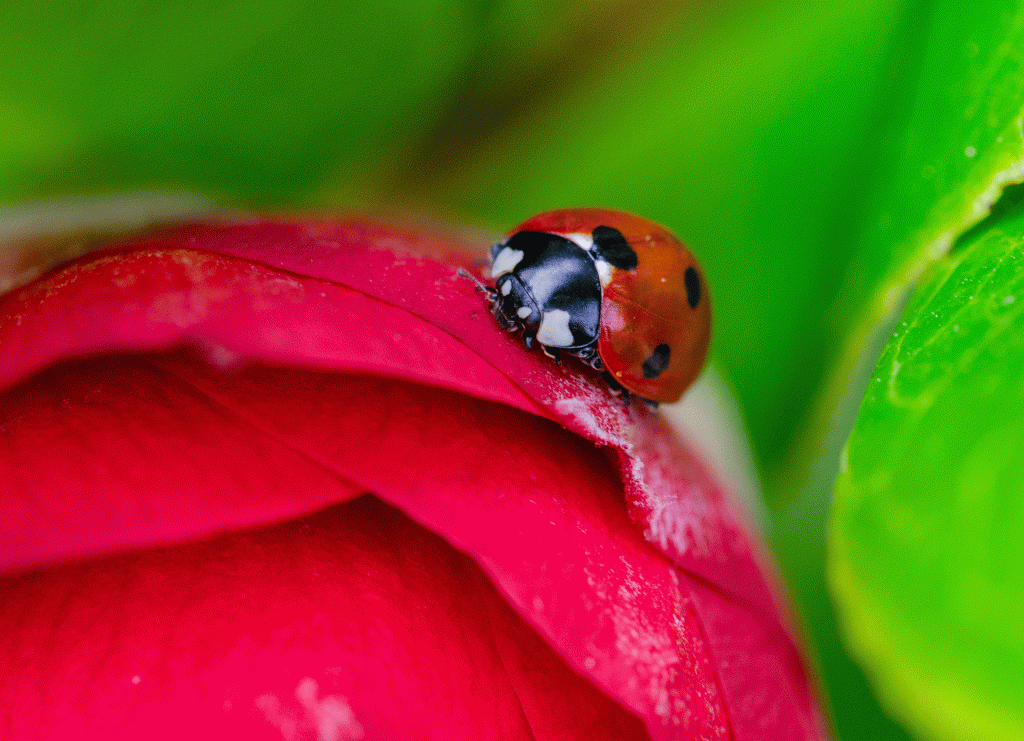
A day of surprises too. Pardon the colour clash between the camellia and the ladybird: all is forgiven because of the sterling work the bugs do. Hidden away in hibernation until now, they are popping up all over- I’ve been trying to “spot” them… (Sorry! Couldn’t resist the joke.)

There are so many parallels between gardening and spiritual growth. We all want the pretty flowers and good-to-eat crops. The hard graft is less popular. Digging out deep-rooted weeds/habits; pruning the ordinary in order to develop the extraordinary. Picking up the litter, mowing the grass, fighting the bad bugs-and-slugs… Left unchecked, our neat growth becomes a wilderness – swiftly.

Finding allies and mentors is so important. Having a good notion as to which things will thrive where- and creating special conditions for the ones we treasure but need extra work and care.

Never stop learning: that’s definitely true in both realms.

Finally, knowing the Head Gardener is a “big help” i.e., VITAL. And, of course, remembering that gardens (and lives) are there to be enjoyed as much as possible. All graft and no tea in the shade makes a grouchy human. Stopping to enjoy the wild life- butterflies, birdsong, ladybirds gnashing the aphids… PRICELESS.

There IS a prize. Philippians 1:6 (NLT) says:
“And I am certain that God, who began the good work within you, will continue his work until it is finally finished on the day when Christ Jesus returns.”

The hard labour is NOT in vain.

Decisions! – Look, See, Pray

All the garden suppliers are sending their catalogues and special offers. It’s making me yearn for the glorious colours of summer! Shall I plant more gladioli? What about the older lavender bushes- time for a change? Is there room for another rose? Or two?

Decisions, decisions. And of course those marvellous offers involve spending money (no gardener ever has trouble doing that!!!) but some of them are offering enough quantities to fill Kew Gardens. If only they could see the restricted space available… where could I put 120 dahlias anyway? With the flowering cherry “designed for small gardens” which is tempting me? Or a dwarf crab apple, perhaps?

One decision is made. I would like a passion flower to climb along the rear fence. The old rambling rose already there only flowers for a couple of weeks- and I’d like more colour for longer.

Once the local water table drops a bit I’ll be “at it” tidying and designing… I’d say “watch this space” but there isn’t any yet.

If only I found it as easy to plan my spiritual growth! Questions like “how have I matured since last year” and “what about reducing that pile of books to read by READING some more” are very niggly. It is of course quite normal to have six or seven books on the go at once… isn’t it? Please say yes…

Jesus talked about us being part of the Vine and being fruitful. The process isn’t straightforward. Pruning gets mentioned… Gulp… And then Jesus says this:

“My command is this: Love each other as I have loved you. Greater love has no one than this: to lay down one’s life for one’s friends. You are my friends if you do what I command. I no longer call you servants, because a servant does not know his master’s business. Instead, I have called you friends, for everything that I learned from my Father I have made known to you. You did not choose me, but I chose you and appointed you so that you might go and bear fruit- fruit that will last- and so that whatever you ask in my name the Father will give you. This is my command: Love each other.”
(John 15 v12-17)

Lord of the Slugs- Look, See, Pray

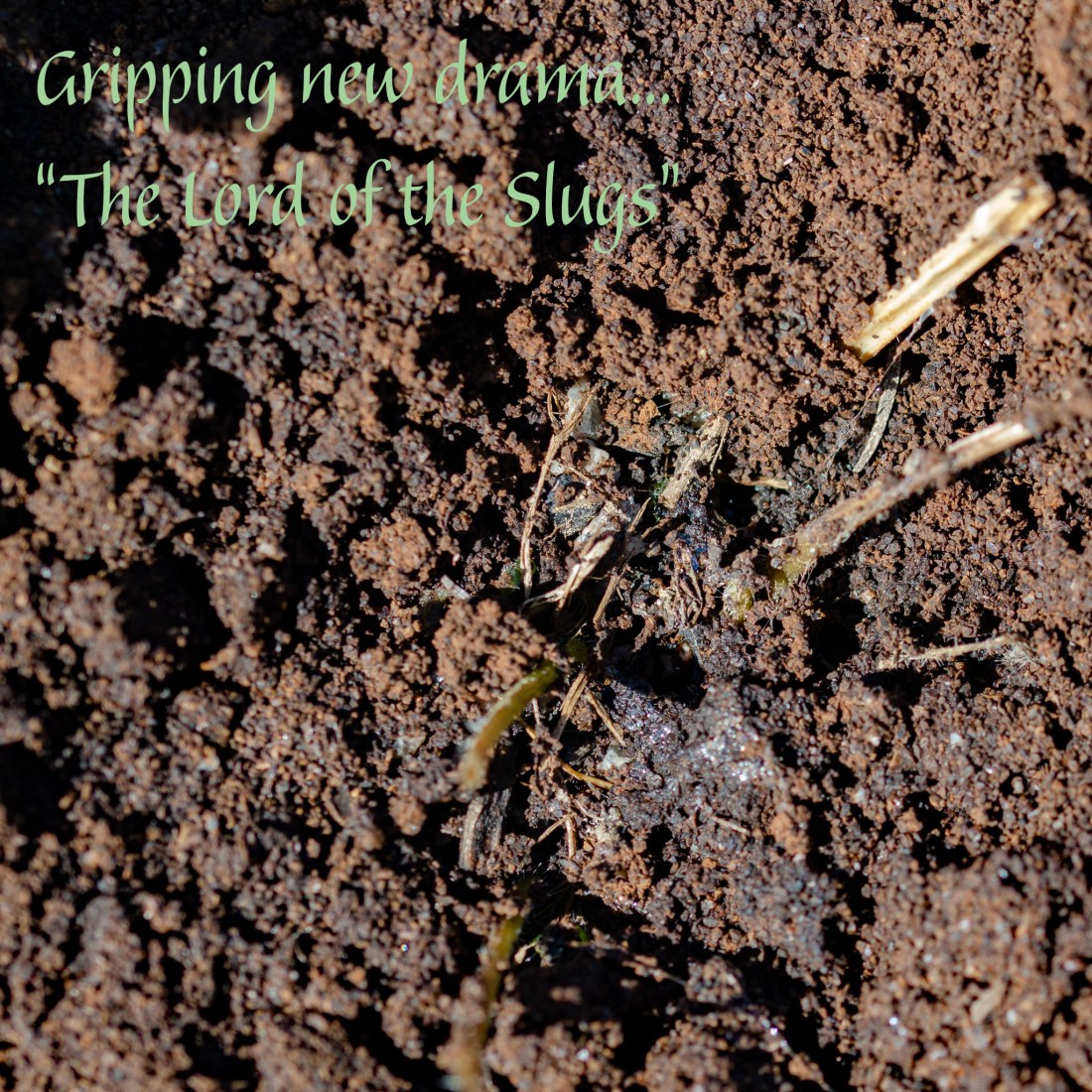
You know how people post their best photos, successes, nicest meals, etc.? Look at this one! Wow!

This is my prized delphinium. Slugs have pitilessly invaded and savagely chomped everything green- despite sharp grit and coffee grounds (both ignored) and then beer traps (which thinned out the numbers).

An evil slug mastermind must be plotting harm… but I am determined not to lose! I have just dug out and re-potted the delphinium’s skeleton (roots and stumpy bits) and put it well away from the Sluglord. And the nematodes are coming… the cavalry that routs slugs, rooting them out…

My delphinium still looks rather tragic. Will it survive?

God specialises in restoration, renewal, and re-creation. It is the message of salvation and reconciliation that runs through the Bible. The prophet Joel gave a promise of hope:

“So I will restore to you the years that the swarming locust has eaten, the crawling locust, the consuming locust, and the chewing locust…” Joel 2 v25 (just substitute “slug” for “locust” !!!)

Shortly after in this passage Joel gives the promise that was fulfilled on the Day of Pentecost:

“And it shall come to pass afterward

That I will pour out My Spirit on all flesh;

Your sons and your daughters shall prophesy,

Your old men shall dream dreams,

Your young men shall see visions.

And also on My menservants and on My maidservants

I will pour out My Spirit in those days.”

Joel 2 v28-29.

Of course, what Joel said is about far more important things than one slug-shredded delphinium! But the principle is sound. Even when years have been wasted or ruined (pandemic, anyone?) or our lives have been torn and turned upside down- God can restore and heal.

I’d love to see my delphinium flower tall in “Midnight Blue” and even though it seems to taste like honey to slugs, I will NOT stop trying.

And though there are sad memories, failures and pain from the past, I will NOT stop trying to growing a beautiful life that shows godly beauty: because I believe God can do wonderful things despite locusts, slugs, and my weaknesses and limitations.

Please, Heavenly Father, pour out your Spirit today!

Living Joy- Look, See, Pray

Grey, dull miserable… that’s just the BBC. Outside: add drizzling, damp, cool, windy weather. What a start to Wednesday.

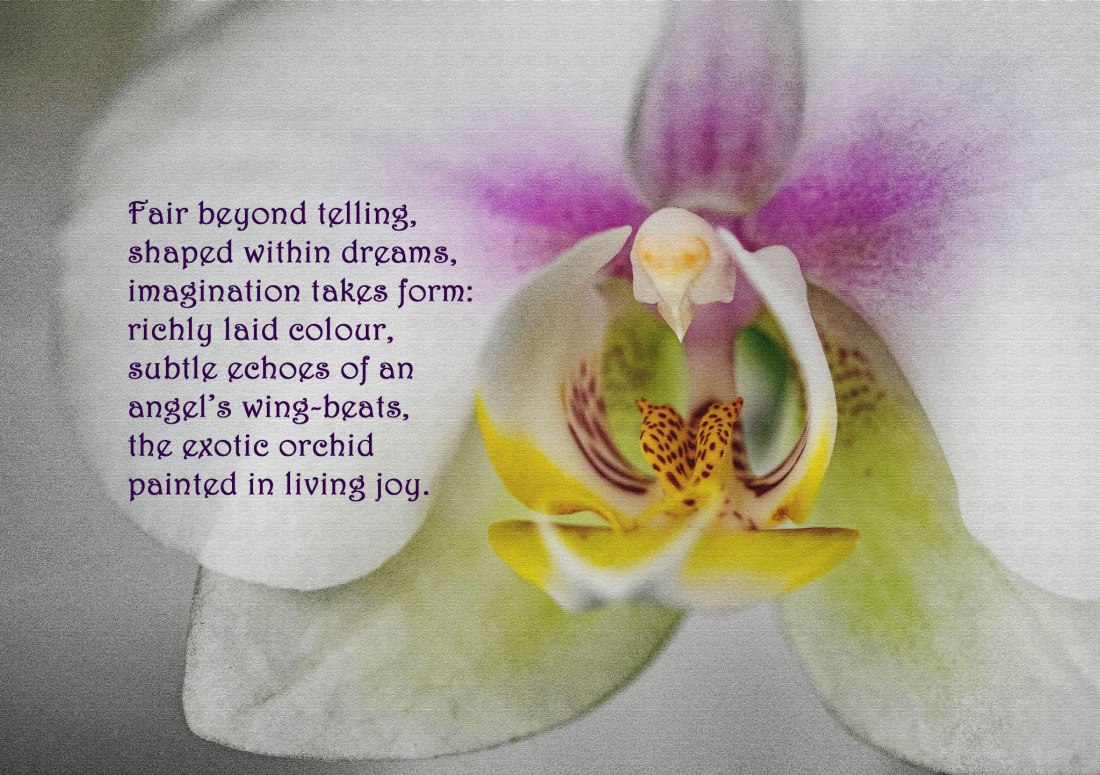
Then the display of orchids on my windowsill changed the way I perceived the day. A white one with yellow and pink; yellow and purple with two sprays of blooms; and the purple and white-spotted one. Immediately, my mind shifted gear: and I wrote a few lines trying to capture in words what I was feeling. The shape and colour fascinated and inspired heart and soul: such exotic beauty lifted my spirits and restored joy to life. So, go find a flower!

The WAY we see is as important as WHAT we see. Our perception of life is determined by our focus and choices.

“Joy does not simply happen to us. We have to choose joy and keep choosing it every day.” Henri Nouwen

So my view of today has been shaped by the vivid creative imagination of God, who thought about orchids- and I’m deeply grateful for living joy!

Fair beyond telling, 
shaped within dreams, 
imagination takes form: 
richly laid colour, 
subtle echoes of an angel’s wing-beats, 
the exotic orchid  
painted in living joy.             © Richard Starling 2022

Even better than any poem, and even more wonderful than an orchid, as we get closer to Good Friday & Easter Sunday we can focus on Jesus. The story of his final journey is full of rich teaching and memorable moments and records his determination to fulfil his mission, whatever the personal cost. Reading this story will change the way we see life- because Jesus changed the ending. How then shall we live?

“Looking to Jesus, the founder and perfecter of our faith, who for the joy that was set before him endured the cross, despising the shame, and is seated at the right hand of the throne of God.”   

Hebrews 12v2

Joy in January? Look, See, Pray

January… the crown of winter’s dreary days! It’s not all bad: but it is notoriously fickle and grey. Short daylight hours, cold, damp, and it’s time to get rid of the excess pounds after the Christmas extravagances. A true recipe for joyful living.

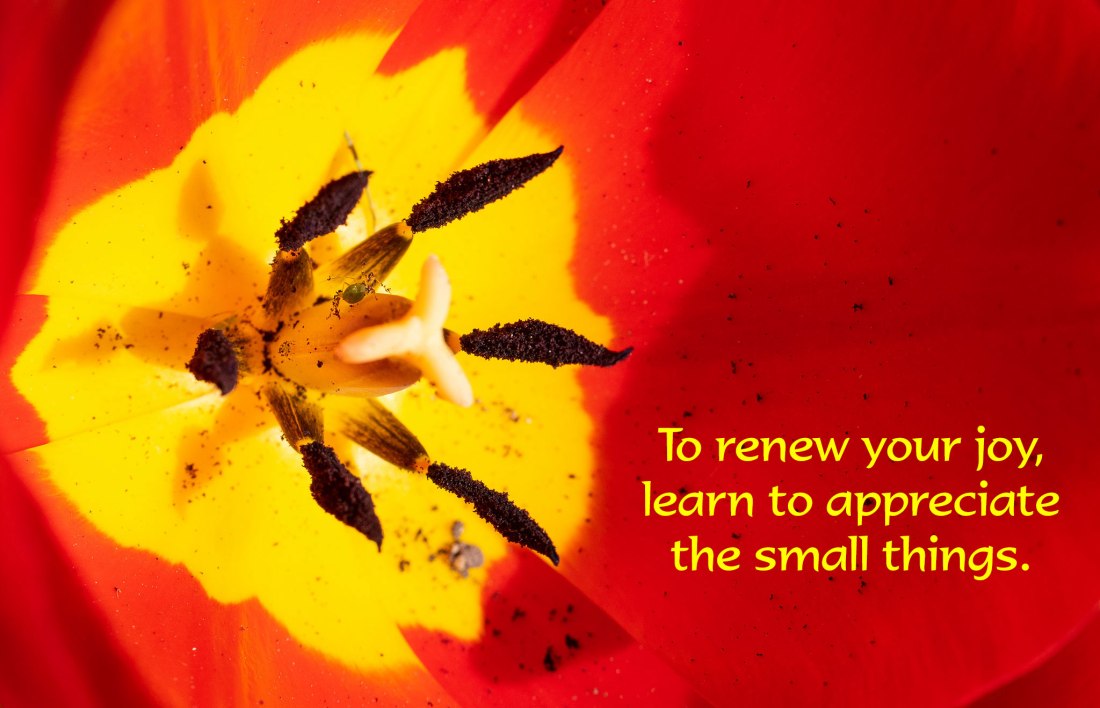
Can we renew our joy? Perhaps this picture can help.I’ve never seen a dull red tulip. None in the garden, so I’ve hunted this out from my photo albums. Gloriously scarlet, then an even brighter yellow inside. Just for added impact, starkly geometrical black stamens contrast violently in alien shapes. Looking more closely, speckles of black pollen give a mute testimony to the visit of an early bee. Do these specks spoil the bloom, or remind us of life and growth to come? Can you spot the aphid? I only noticed this today. A pest, or another little miracle of life?

A principle of photography is that the actual subject should be the most important thing in the photo. A common mistake is to make the subject too small. It is lost in the background, and the picture loses impact.

Getting in close makes a difference. This picture shouts “I’m a tulip!” in dramatic tones. It would be easy to walk past the flower beds, camera at head-height, and take a picture of some “nice tulips.” Beauty turned into a vague generalisation!

When we need to renew the sense of joy, the experience of lightness of spirit and being at peace in our world, a great way to start is to pay attention to the small things, the details, the abundance of life all round us. Attention given leads to awareness, appreciation, and a deep gratitude for the richness that is here.

This works in relationships: when did you last tell your partner or friend or colleague that you appreciate what they have done and what they add to your life?

It’s a vital part of faith, too. When you see that first snowdrop, or the daffs beginning to emerge, will you SAY “thank you” to God? Not just thinking it, but putting gratitude into spoken words- it releases a powerful surge of joy.

God is present in our world: and has compassionate love for His creation. Acknowledging His love and majesty “tunes us in” to the love-song God sings over us. In knowing this, we find renewed joy. It could start with a tulip… or with the hope of a psalm:

Where can I go from your Spirit? Where can I flee from your presence? If I go up to the heavens, you are there; if I make my bed in the depths, you are there. If I rise on the wings of the dawn, if I settle on the far side of the sea, even there your hand will guide me, your right hand will hold me fast. If I say, “Surely the darkness will hide me and the light become night around me,” even the darkness will not be dark to you; the night will shine like the day, for darkness is as light to you.

The Holy Bible: Today’s New International Version. (Ps 139:7–12). (2005). Zondervan.