Long ago
Far away
in the dark
a new beginning began.

Child of eternity
taking humanity
as Mary and Joseph
took responsibility.

Baby to cherish,
witnessed by angels
by shepherds
a Star.

The most fruitful harvest
comes from tender petals... Sweet flower.
The One true Saviour
embraced our frail shell.

It's done.
Jesus is born in humble place
with gifts
gold, frankincense and myrrh
foretelling
a Cross in His future
and then
Resurrection.

This is Christmas. The beginning begins.


(c) Richard Starling, 2020
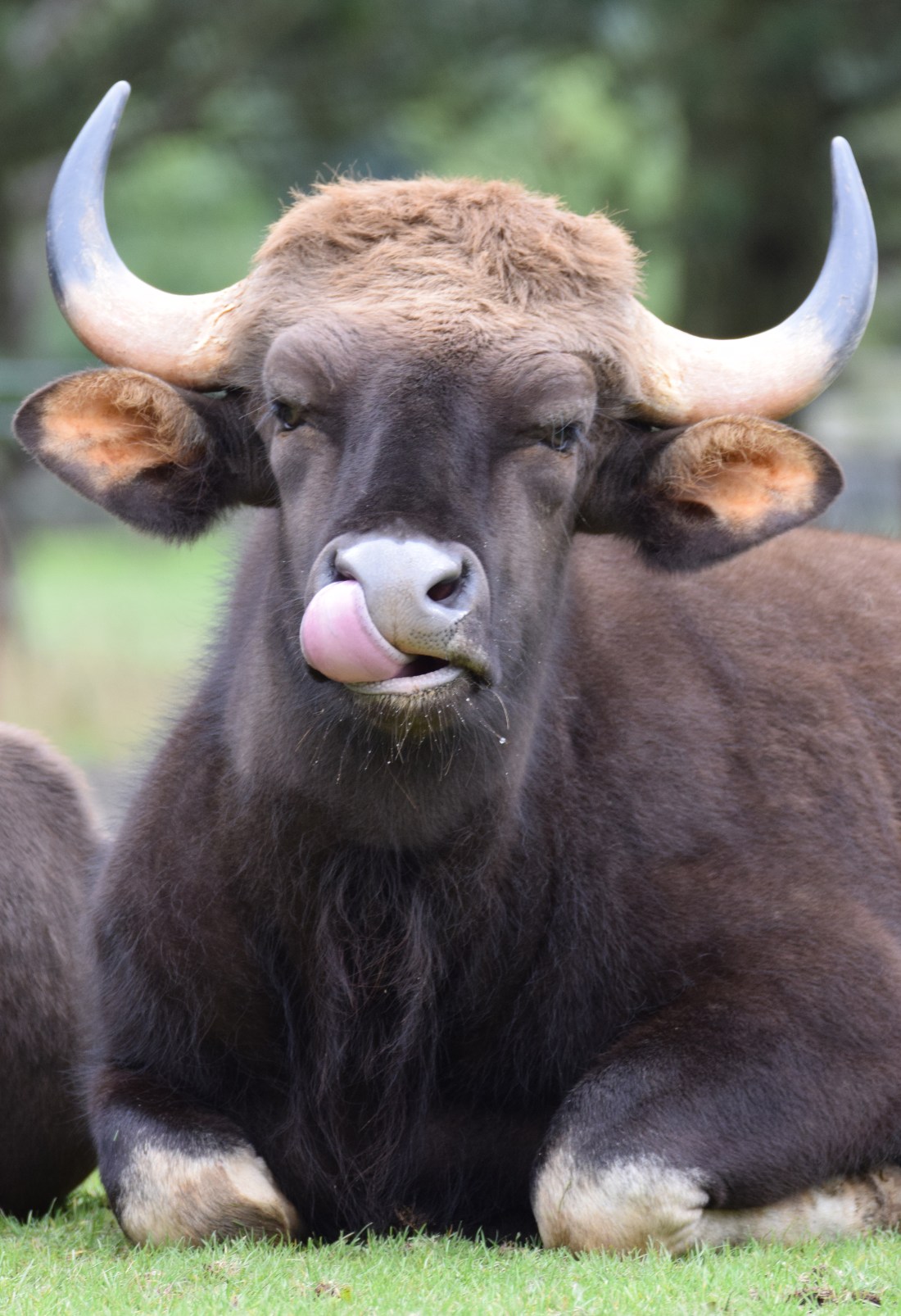
It’s not every day you meet a gaur ox… six feet high, heavy enough to make me feel slender, those big, dark, placid eyes… and the ability to shove his tongue up his own nostrils. After a few minutes of staring at each other, the ox settled down and, once sitting comfortably, it seemed he was ready to tell me a story… I often wonder what stories animals would tell if they could (Can’t help having an active imagination!) so my mind began to wander. I love stories. Once upon a time Gaur- he has to have a name, so why not?- listened to his great-great-great-Grandfather Muuuh telling an evening story as the herd chewed its cud and the ox-calves burped warm milky wind…
“Once upon a time, in a land far far away, our forebears lived in a hot hilly town where we worked so, so hard. Some days we ploughed the fields, or pulled up trees. Our owner fastened a heavy yoke on our shoulders and tied ropes to our harness so we could do what those weak men couldn’t do for themselves. We were proud of being strong, and brave, and stubborn- even more stubborn than those donkeys! And our deep voices drowned out those annoying brays- lightweights, those donkeys, can’t think they’d ever be much use… Anyway, said Muuuh, they had an adventure! There’s one night that every ox remembers with pride. It went like this. “It was a difficult plod back to the stable that evening. The roads were choked with people, and we had to barge our way through to get home. We were late for our hay- and on the journey we saw a bright Star shining, high in the darkening sky, so pretty. Home in our pen at last, guzzling our hay, we were just getting ready to doze off and a frightful clatter made us jump! The door had been dragged open and a donkey clattered her hooves on the stones. In came a man and a very fat lady, looking weary and rather bedraggled. She cried out sharply. and grabbed at her stomach, and started breathing hard. The man put her down on a fairly clean bit of straw, and she shrieked! That’s when I realised. She wasn’t fat, she was about to have a calf! It seemed to take a long time, with noises and tears and yells- then a different noise- a wail, a sobbing cry… Poor calf, I thought, can’t even moo. And it isn’t even trying to stand up, poor thing. That’s when, of all things, the woman wrapped some cloth round the young one, and PUT IN IN MY DINNER TROUGH, right on my soft sweet hay! Cheek. I was going to have that for breakfast. The night seemed long and starlight shone brightly through the crack in the door. I stamped my hooves, then pricked up my ears… someone was coming. Several, in fact. The man met them at the door, and tried to send them away. But they talked quickly, urgently, and a caught a few words… Something about “angels” and visions and Light… then someone lost hold of some silly little lamb and for a few moments it was chaos. Then the man spoke again, and pointed at the woman, and the calf in the trough, and said “Sent by God… Love has been sent from Heaven to Earth…” The new arrivals, who smelled of sheep, just smiled and fell on their knees… and the new mother smiled and nodded, and they all looked so happy. Later on the sun came up, and we went out to work, gently ruminating on what had happened.” We oxen, said Muuuh, have always repeated that Story. Because if what those shepherds said is true, then it was the best night any oxen have seen. The mighty One who made us strong has changed the world with a little, crying, weak thing who the man called Jesus. Who knows what will happen next? It’s beyond any Ox to know… but look up at the sky tonight… Maybe we’ll see a Star…”
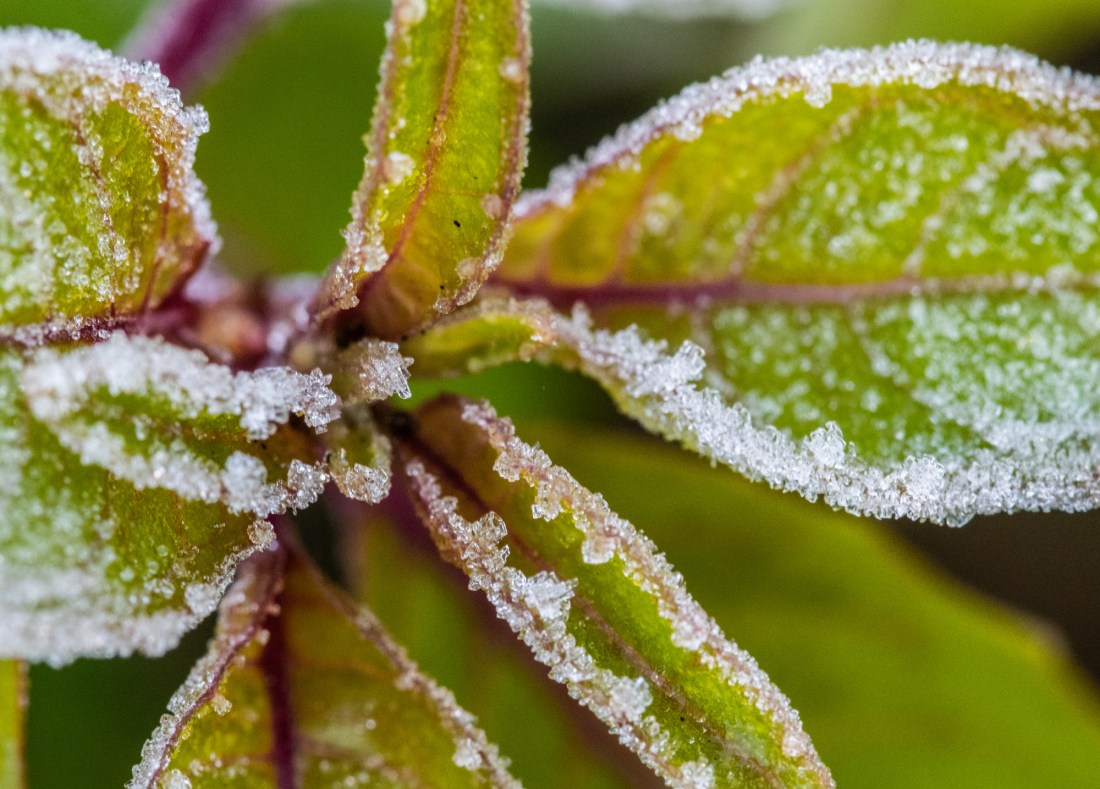
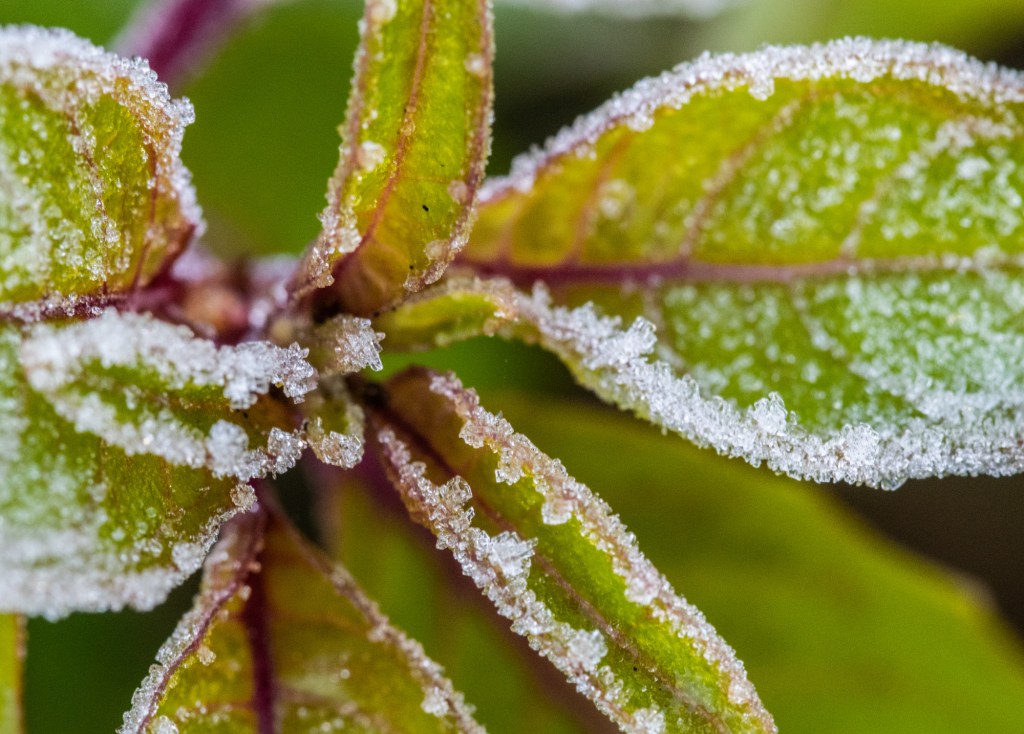
Hardy or tender? This has suddenly become the priority question for English gardeners. Frost is starting to turn our gardens into a killing zone. Colourful stars of the summer like dahlias and pelargoniums are quaking to their roots! Shrubs like this fuchsia have had a rude awakening… some must be rescued, others may survive- time will tell.
Hardy plants are so useful: year after year, through summer and winter, they survive almost anything the seasons send against them. Tough as boots, some of them.
Tender specimens can fall over at the first crystalline kiss of Jack Frost.
Both types have their beauty and distinctive contribution to make. Our British gardens are enriched by species collected from all over the world: but we have to learn about their needs, vulnerabilities, and how to place them to best advantage. And, of course, our native plants also have riches to add to our treasury of colour, form, and fruit.
The problem is this. A novice gardener has to learn (often the hard way!) and frequently is taught by the change of external circumstances. Winter is coming…
I suppose you could draw a parallel with people and organisations. This year has slapped our faces with a dangerous illness. We react to the new circumstances according to our essential nature- there is loss, hardship, courage, despair, and hope… When the new season begins, what will still be standing? What will re-grow? What is gone for ever?
From a church viewpoint, I have noticed a miracle! Nobody has said “We’ve never done it this way before…”
We have made use of Zoom, given thanks for broadband, tried to find new ways to care for each other, offer pastoral support, pray and worship, teach and encourage. Are those efforts perfect? No. But they are good. Do we miss meeting together? Of course.
We’ve never done it before… So let’s do it NOW! Let’s work together, challenge discrimination and injustice, let’s share love, compassion and sincere faith. Let’s change the things that were broken for something new and better!
Some church denominations (whose way of being church is based on a priestly, sacramental, and heirarchical theology) are pleading with the government for permission to meet in their church buildings. There is a clash between their way of “doing church” and the “love your neighbour by not giving them Covid-19.”
Other church fellowships are saying the Government “has no authority to tell us not to worship God.”
I understand their opinions and pain. Our year is blighted by frost! Yet I believe our response to the horrible change of circumstances could be more adventurous. It is an opportunity to live out our faith in different ways and discover that new methods can still be life-giving and worshipful. All of us should be observing sensible rules on distancing, using masks, maximising hygiene, protecting the most vulnerable- wherever we worship.
I miss not meeting with others: family, friends, church. I’ll queue up for the vaccines which can help restore “normal” life. But I really hope that we won’t just go back to the ways things were. Those ways are broken. Society is broken. Families are broken. The racism, poverty and injustice that afflicted too many should NOT be re-instated by default.
Jesus spoke of “new wine needing new wineskins.” New life can’t be contained in worn-out, brittle institutions.
He also said “My Father is the Gardener.”
May the Gardener tend us all, so that next year will be full of colourful flowers, strong plants, and a great harvest.
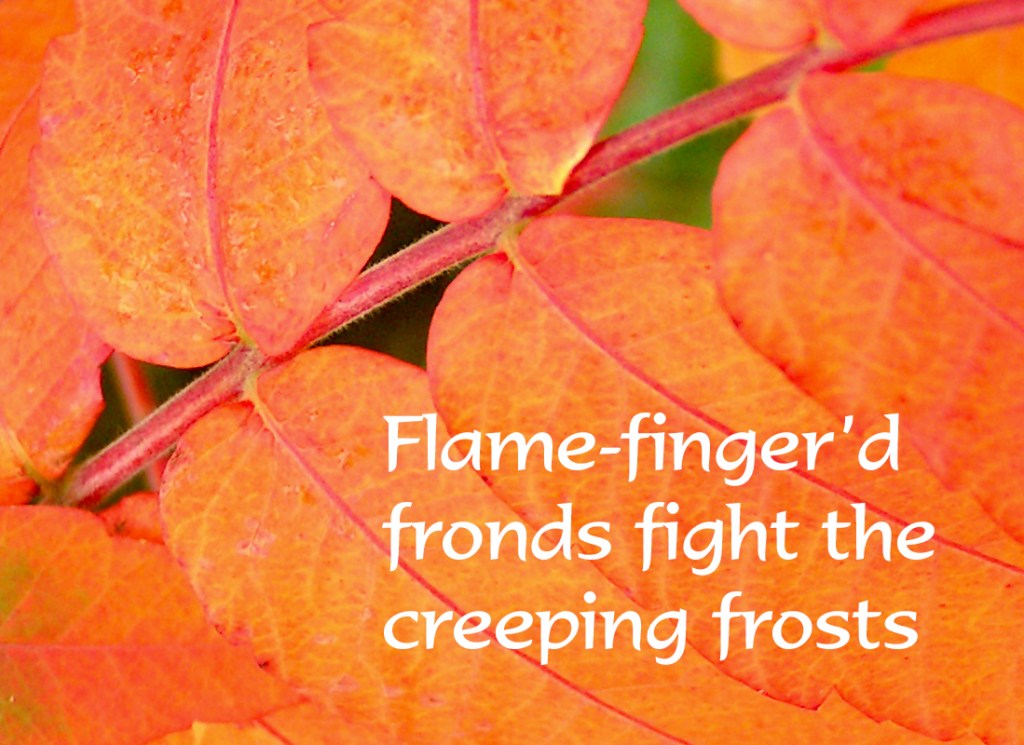
Flame-finger’d fronds fight the creeping frost. October gone, so winter’s eye turns to leaves not yet vanquished in the cold. How long to stay? November gales shriek, laughing, for summer is but memory- and leaf-husks rattle at the roots.
Bold glow of orange, crimson stems, holding remember’d warmth – Clinging to shades of Spring gone by when days were long and sap rose swift in triumph and strength, now lost… Can we hold till Christmas? Or must yield to holly and captive firs making merry at the wake of the season?
In restful peace we shall sleep, careless of snow and icy dawns. Deep in the earth our strength lies hidden until lengthening days and warming Sun bid us reach for the heavens and sound the trumpet of daffodil’s Spring. For now, whilst our flames can hold tight, we give joy to the soul of those growing cold.
Prayers and poems grasp promises that life and love and God may seem to pause in winter’s chill yet Renewed again, and rested, we shall stand. Colours leaking to leaf-mould now are never wasted, but shall return. God speaks in colours! Nature sings a symphony, music for the soul.
Silent now Thunder of guns faded no shouts or screams to remember the ones whose footsteps lingered in muddy fields.
Nothing here until poppy-seeds buried come to flower in blood-soaked clay. And poets, seeking to soften loss of so many, too soon, Saw each petal, flower, and stem as soldiers standing to mourn.
Not just the fields Warfare blights the deserts, the skies and sea. Countless men, fathers, brothers, sons Women, too, have paid with blood and sorrow Children plucked from homes communities shattered, bombed, derided- Where is the Dove of Peace?
If only all war were just If only war were no more.
Blood-red poppies from the battlefields tell the story of courage and loss. We will remember we will honour their memory we will grieve their passing and thankfully receive freedom, not to be taken carelessly or held in scorn.
We will remember the ones who never came home- and those who came back changed and lost. Blind and maimed, with empty eyes, and shadowed thoughts.
We will remember. A poppy worn in remembrance, in hope of lasting peace, a yearning for justice and fairness for all. A poppy worn for what has been and for what, we pray, may not come again.
Now for widow, orphan, refugee and victim may there be hope of peace of safety, of a home where war does not call. May sword be re-cycled and rifle laid aside and tanks and planes and battleships fall into disuse until they rust and war shall be no more.
Then the blood-red poppy shall be left to grow in peace.
I’ve done it again! Despite multiple failures, I’ve done it again. Will I ever learn?
A pleasant if wearying session in the garden, weeding out the really successful plants (weeds) and making room for the hopefuls for next Spring. I have planted crocus (crocii, crocuses, take your pick) once again. Not a good track record, never yet does the reality match my dream. So this year I’ve cheated. I have NOT planted any yellow ones- in my experience yellow crocus is just a salad bar for early slugs and naughty birds.
So then, purple, plus purple/white stripes, and pale lilac-colour. Cracked it! It was lovely to have my hands in the soil, pulling wicked weed roots, ripping out the dying marigolds, and making room for the greatest show on earth! 2021, Aldwick, West Sussex- the best display of crocus EVER.
This is being a gardener. It is a life of undying passionate optimistic HOPE. That which I have planted SHALL be floriferous, gaudy, and perfectly gorgeous. There, see, I’ve said it- again.
If only the RHS gave gold medals for dandelion or couch grass. Did you know couch grass has other names? “Twitch” or “scutch” or “Aarrgghhh.”
“Scutch” sounds like a loathsome skin disease… should I pray and command it to be healed, and never return?
Time for some better and more responsible theology, I think! The thing common to true gardeners is the kind of hope that carries on from year to year, always confident that this time the sweat will earn rewards of beauty, or stunning veg, or sumptious fruit. It is a lifestyle of hope despite hard labour and many discouragements.
Now I ache. All of me aches. Kneeling… not sure if getting down there is hardest, or getting back up… I gave the grass its final(?) cut for 2020, planted crocus and alliums, moved a couple of plants, put down mulch, pulled up this years’ crop of annuals, swept the path… and somewhere during all that I had a sudden sense of physical and emotional relief. Two reasons- first, I heard the very welcome news that “Scutch” Trump lost the election and may be composted in January: and second, the sheer joy of working with living, growing things of beauty and great potential. A surge of hope and confidence! Simply lovely. But I still ache.
We can live in hope, or shrivel in despair. Sheer hard graft may be essential (especially in the garden!) and doing the hard yards can be discouraging. Here are a few words from the Apostle Paul, addressed to the early Church. Hopeful words… when we sow/plant, we have hope of a harvest.
“Let us not become weary in doing good, for at the proper time we will reap a harvest if we do not give up.” – Galatians 6:9 (ANIV)
“So let’s not allow ourselves to get fatigued doing good. At the right time we will harvest a good crop if we don’t give up, or quit.” – The Message.
“There’s nothing to see. Move on” said the small group of walkers who paused to see what I was looking at. Yet I spent a happy half-hour looking at this “nothing.” I had a reason.
Can you work out the missing element?
It is mid-October, about 4pm. Until 4.30pm. As I stood, leaning on the fence, everything was still. Scarcely a ripple on the water, very light breeze, and almost complete silence. So peaceful! I was content and stayed focussed on just being there.
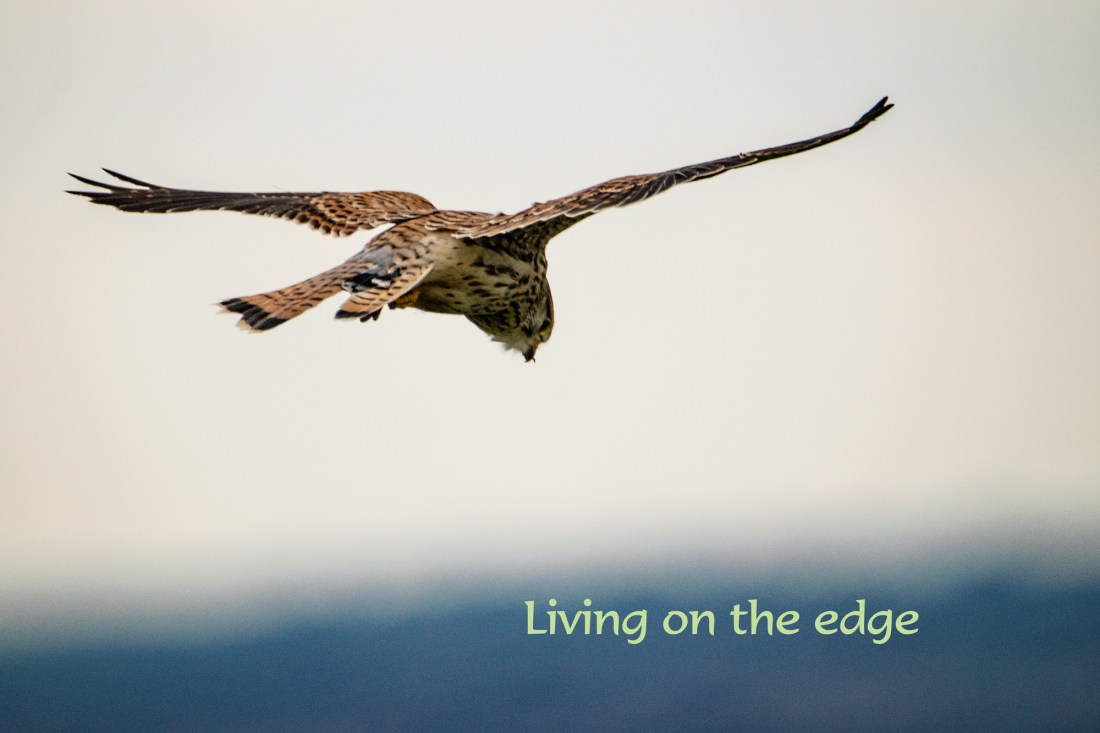
Time is what the photo misses. It is frozen history, a moment that is past forever. But because I gave this scene time, I witnessed life. You, the reader, can’t see or hear this Life- you weren’t there, or you moved on too swiftly. Over beyond those reedy mudflats, two swans set off to a lakelet behind the North Wall of the RSPB Reserve. The place was so still, I heard the sound of the wind through the pinions of their wings, swooshing forcefully with every downbeat. An Oystercatcher swept by heading for the beach. Dunlins sprang up and dashed like a high-speed train inches above the water. Ducks passed by, a kestrel hovered spying on the mammal morsels she sought to invite for supper. The piping calls of wading birds echoed across the placid water.
Nothing to see? Rubbish! This scene just needed some time and attention.
So it can be with “hearing God” or even just trying to pray. We give a few moments, but we’re not tuned in. We see nothing of interest, hear nothing to take our attention. What if we invested more time? A day, a week, maybe an hour or two. Perhaps we would hear a gentle Voice of relieved Love- “At last! You can hear me!” – as our senses are sharpened and our attention made real.
I do not think there is any shortcut to hearing God. But giving time and attention is a great start.
God sometimes takes the initiative- He may call out to us, or communicate via a prophet, preacher or stranger. The Holy Bible is the record of what He has already said. Holy Spirit insight may be given in several ways. The Old Testament writers like Amos, Jeremiah, and the Chronicler point out that “If you look for me wholeheartedly, you will find me.” Jeremiah 29:13 (NLT).
2 Chronicles 15:1 (NLT) Then the Spirit of God came upon Azariah son of Oded, and he went out to meet King Asa as he was returning from the battle. “Listen to me, Asa!” he shouted. “Listen, all you people of Judah and Benjamin! The LORD will stay with you as long as you stay with him! Whenever you seek him, you will find him. But if you abandon him, he will abandon you.…”
Verse 8 tells us that King Asa “heard the words of the prophet and took courage.” Asa became a good king, faithful to God and to the people: he introduced vital reforms, and mostly did well. He sought God with all his heart. He gave time, attention, and obedience.
Perhaps you are “stuck” in a place or time where there is “nothing to see” and you are frustrated. The halls of heaven echo silence.
In that silence the Lord may speak. Wait. (We don’t like waiting, we live in an “instant” society.) Use the time, embrace the silence, cling on to the truth that God is the Revealer and Reconciler. Look for God wholeheartedly: don’t rush away despairingly. In the silence and in peace or turmoil- God will speak.
“Silent” and “Listen” have the same letters, just in a different order; and being silent is often the first step of listening. Start right here, right now.
Living without hope is soul-destroying. Hopelessness eats at our spirit, our courage, our relationships and even our ability to love. Then we give up. Or we start to try experimenting with ridiculous risks or harmful actions.
“Acceptable social anaesthetics” like drugs, alcohol or sexual indulgence offer temporary relief: but if there is a vacuum at the centre, everything is sucked in and destroyed. As a follower of Jesus Christ, I may seek bigger experiences, zingier worship, allow my faith to collapse- or I can build on my foundation.
WHAT we focus on will affect our day-to-day mood and actions.
WHO we focus on will determine our story’s end.
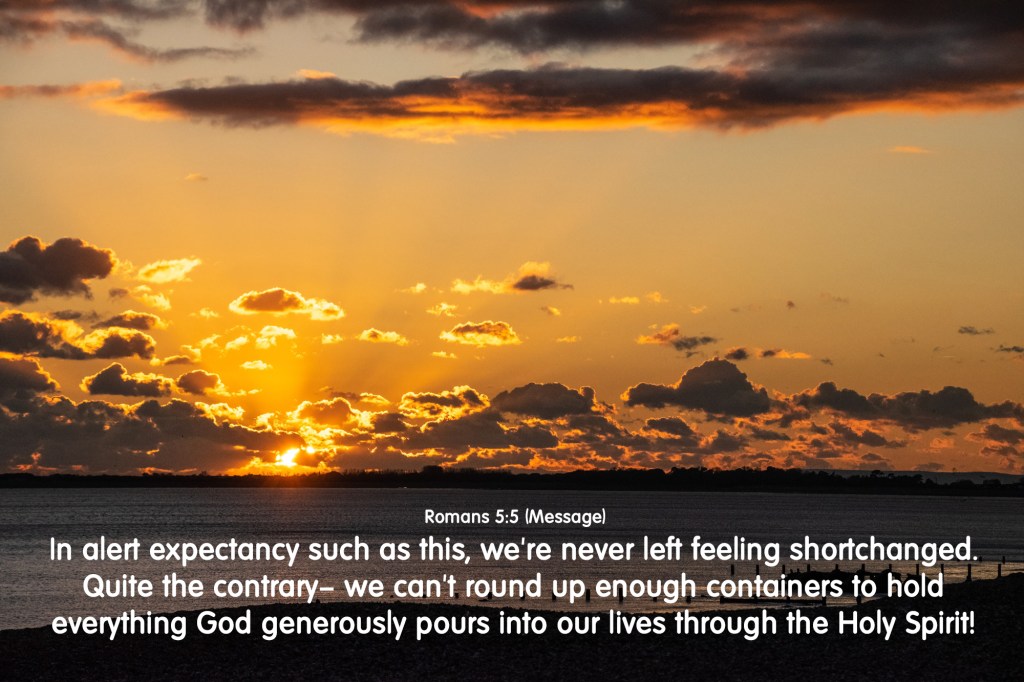
I count myself blessed to be living near the sea. Autumn means the beaches are mostly empty, and the sunrise and sunsets are a personal art gallery to be enjoyed and cherished. The other day I watched small waves coming in at an angle of about 25 degrees to the shoreline. As they broke there was a long succession of noise as the water curved onto the stones, like a succession dive by a line of synchronised swimmers. It was almost hypnotic- certainly very calming.
Perhaps it is in these observations of the wonder of creation that we can find reminders of God. Combine that with a reflection on God’s revealed Word, and we can find encouragement to strengthen our minds and our spirits.
The grateful heart finds hope in counting these blessings and the solidity of the world- the Faithful God is revealed in the faithful repetition of sea, land and sky. There can be- will be- storms and disasters- but they pass and new days come. So far, I have a 100% record of surviving life… and a growing bundle of joy-filled photos to remind me that God IS… He is LOVE… AND HE IS FAITHFUL.
My choice is important. What and WHO will I focus on? That’s where I will find hope.
Psalm 33:22 (NLT) Let your unfailing love surround us, LORD, for our hope is in you alone.
I’ve been reading Tanya Marlow’s helpful little book “Coming back to God when you feel empty” which sets her story of serious personal illness against the story of Ruth & Naomi (Book Of Ruth).
Reality for many of us is that we have times of sadness, frustration, or annoyance. Try as we might to be “poster boy/girl” of perfection as Christ-followers, life persists in poking spanners in our plans. Perhaps we have been (badly) taught that a Christian should be always smiling, calm, successful and never cross. When you started your experience of Christ and His Church, were you issued with your SWEG? Mandatory a few years ago, the “Slimy Wet Evangelical Grin” divided the failures from the REAL people of faith.
Well, in “Ruth” we have a story set in dangerous days when Israel was mostly doing whatever they liked, and God had to keep sending leaders (Judges) to sort them out. Naomi gave up on God because a famine lasted too long; then went to Moab, where the Lord had forbidden Israelites to go. Tragedy followed- her husband died, her sons marry- but also die- and her sensible daughter-in-law skipped out. Naomi was understandably grumpy, and even told people she was called “Bitter.” The story has a brilliant and happy ending (read it, it’s quite short) and God uses Naomi, Ruth, and a man named Boaz to be part of the story that leads up to the Incarnation of Jesus.
Some of you are thinking “Grumpy?” Others are offended by the “SWEG” comment. Tough. Be real.
A surprising number of Bible characters get grumpy, and don’t grin like loons. The Bible tells it straight, warts and grumps included. Moses, Jacob, Elijah, Elisha, Amos, Nehemiah… the list goes on. Grumpy is real (although not something to aspire to).
The good bit is this. God understands. Especially when the mucky end of the stick comes our way, when others aggravate us, or persist in holding contradictory opinions, or when circumstances drop us in the swamp… God would rather have our honest grumps than insincere swegs.
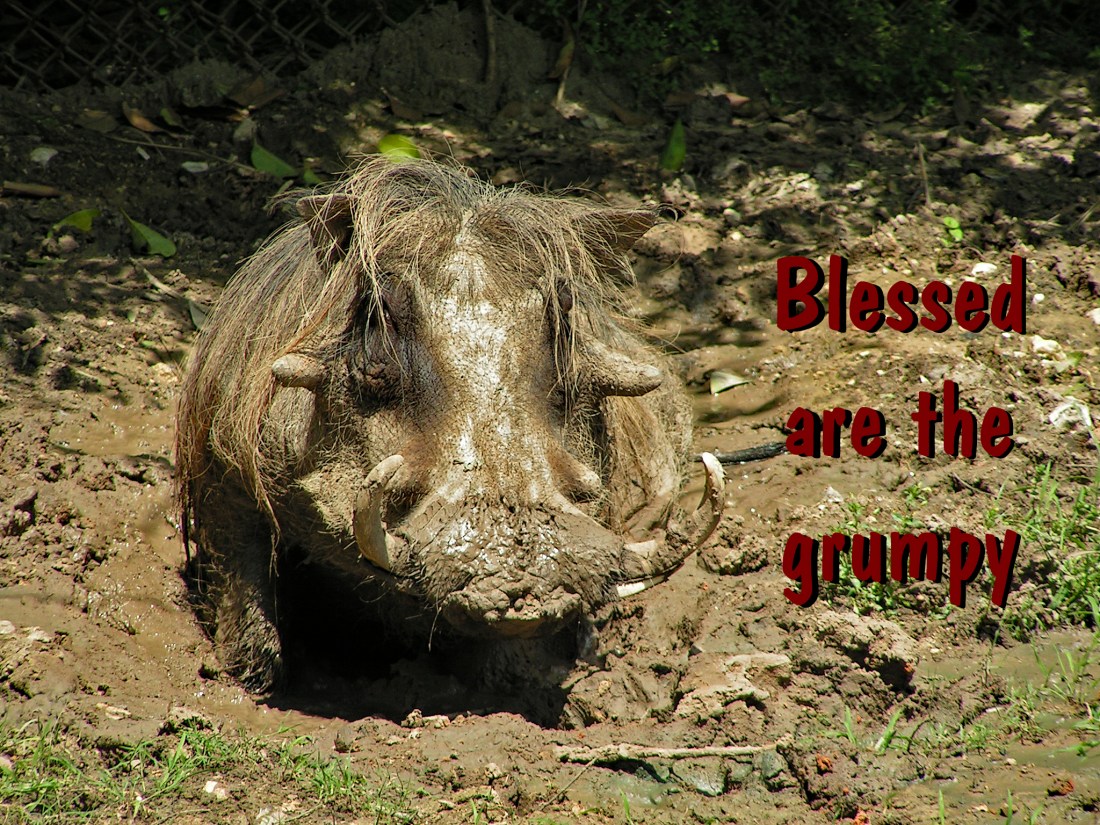
Having gone through life with a passing resemblance to the warthog in the photo, I say passionately that we don’t have to pretend perfection. Praise and thanksgiving ought to be coming out of our heart and mouth regularly- but if you get a Warthog Day please know this: Blessed are the grumpy, for God still loves them and understands.
As a man whose character tends toward smiles and contentment, with a deep conviction that God has been good to me, I still get grumpy (even if I may not show it often). So with all my heart, I thank God for this truth: Blessed are the Grumpy.







 Look, See, Pray