Funny old world… Look, See, Pray

It’s a funny old world, full of surprises.

Number 1– for no known reason… Surprise! A crack across my car windscreen from the corner towards the middle. Deep joy… and the glass people can’t fix it for a week. I don’t know who to blame.

Number 2– came home, took the recycling bin out for collection via the back gate/twitten. Surprise! Some time between Christmas Day and today, an unknown benefactor has removed the timber and old iron that was piled up to be taken to the tip. No note, just a nicely empty space where the old shed remnants had been messily patient. I don’t know who to thank!

So now I don’t know whether to be grumpy or happy.

If we allow our perspective and mood to be purely reactive, we’re at the mercy of the vagaries of the world. Good things happen to bad people. So do bad things- and neither is necessarily anyone’s fault. Nor is a “good” thing necessarily proof that someone is “good.” How can this all make sense?

This is an ancient conundrum, which philosophers and theologians have wrestled with for thousands of years. Is there a reason why ANYTHING exists at all? Is there a “God” who cares about us? Is everything random chance and coincidence, or does life imply meaning and purpose? (This is a vital question- our answer shapes our world.)

Christianity declares that God is real and has made Himself known.

Many years ago the prophet Isaiah proclaimed a message from God which is worth examination. What do you make of this?

Isaiah 45:5–9 (ESV)
I am the LORD, and there is no other,
besides me there is no God;
I equip you, though you do not know me,
that people may know, from the rising of the sun
and from the west, that there is none besides me;
I am the LORD, and there is no other.
I form light and create darkness;
I make well-being and create calamity;
I am the LORD, who does all these things.

“Shower, O heavens, from above,
and let the clouds rain down righteousness;
let the earth open, that salvation and
righteousness may bear fruit;
let the earth cause them both to sprout;
I the LORD have created it.
“Woe to him who strives with him who formed him,
a pot among earthen pots!
Does the clay say to him who forms it,
‘What are you making?’
or ‘Your work has no handles’?"

Frosted Clarity- Look, See, Pray

Frost has outlined these little beauties. Rims and veins have attracted icy crystals which accentuate the shapes and forms of flower, berry and leaf. It makes for a nice picture!

You may be surprised to know it can help us do theology too.

Theology is “God Knowledge/Thinking.” The information we have, the principles we hold to, and the interpretation of God’s revelation enable us to begin to comprehend God. We debate, discuss, argue, theorise, and write BIG books! (Wouldn’t it be helpful sometimes to have a simpler explanation, a short book or cartoon instead? If so, read on about the frosty rose!)

Christians have prepared summaries of what we believe: we call them Creeds. “I believe in God the Father…” is the beginning of the Apostles’ Creed (one of the mainstream standards). These Creeds have been agreed by many believers over many years, and are often familiar to most churchgoers.

Each Creed sets out statements of faith; the things we agree on as “standard” for Christianity. They set out a “map” of faith, rather like the frost on the rose petals. We see where each one fits, what’s “in” as a part of normal faith. (There are, of course, differences of emphasis and nuance between the churches! But bear with me on the main principle.)

We cannot fully comprehend God- but one central Christian belief is that God has been and is self-revealing. We can see the Divine in Creation itself- through beauty and awe. The Bible is a written collection of the history of God’s interaction with humanity, inspired by God and amazingly effective at teaching us about God and His Ways.

I suppose we could write different doctrines on every petal to make it even clearer. For example: the nature of God; Creation; Salvation; Bible; Ethics, etc., etc.

Theology is the whole rose- but the parts can be looked at separately. We can always discover and experience more of God; so our study is open-ended, and there are “mysteries” as well as plain and obvious truths. But even if the rose is a symbol for theology, God is above and beyond it- the Gardener who is greater than the rose (or the whole garden).

Do you get the idea? Just as the frost has highlighted nature’s beauty, so choosing particular aspects of faith to study helps to make sense of the bigger picture.

The best starting place?

The life, teaching, death and resurrection of Jesus. As set out in the four Gospels, Matthew, Mark, Luke, and John, we are introduced to the best self-revelation of God.

As Jesus said, “If you have seen me, you have seen the Father.” (John 14 v9)

Start here: GO.

Mysterious- Look, See, Pray

Why take a photograph? Using flowers and plants as an example, let’s answer that “why” question.

Before cameras were invented, naturalists illustrated their work with carefully crafted drawings and paintings. Many of these were exquisite, detailed and accurately coloured.

Then came film and modern lenses: almost perfect replicas of the subject, unadulterated by any human mis-perceptions. Such photos are a stunningly accurate copy, which is fine if you are illustrating a textbook. Yet if photography is ART, arguably some different qualities are needed.

The “why” comes into play. What drew the eye to the subject? Is it the shape, the form, the colour, the contrast, the light? Perhaps the scent? Pictures can’t help with that last one!

Art interprets as well as records. By controlling the composition, the lighting, even the lens used, the photographer selects the desired qualities of the subject and then attempts to succeed in capturing a satisfying representation that pleases the eye, mind, and emotions.

Some would say the photo “tells a story” or conveys something important to communicate to the viewer.

What about this picture? It’s a dark-orange sunflower called “Red Sun” and I spotted it one morning just as it was starting to unfurl its petals. It looked spiky and soft at the same time! The gentle light softened the leaf colour, and the unfocused background made the dark petals jag out like a crown of spears against the pale greens and blues.

Tiny, delicate hairs add texture and finer detail as the eye explores.

A few hours, a day later, and the “normal” flower shape would be established and probably make this sunflower more ordinary.

For me, the shape matters: and the harmonious spread of pastel colours behind the dark, stark petals makes me want to look again; it holds my interest, and captures a specific moment in time for this particular plant.

I have to say that I find the concept of random existence and evolution unsatisfying. The qualifying word there is “random.” Faith and science sometimes collide- and sometimes they mutually enrich. All too often scientists and theologians have butted heads like angry goats! Usually, because theologians don’t understand science AND scientists don’t understand theology. (Both disciplines are complex and multi-faceted, and require a lifetime of study in order to reach the point of realising we only scratch the surface of knowledge and meaning. That’s the point at which a bit of humility and mutual respect makes the conversation fruitful.)

Faith asks questions about mystery and addresses those mysteries via the self-revelation of God, which weaves through all things like a glorious golden thread.

Meditation on a photograph, an interpretation of reality, allows the mind and spirit of a human to ponder beauty; and perhaps discern the fingerprint of the Artist. Add to that an examination of the life, nature, and resurrection of Jesus Christ and an Eternal Light shines through into our own present reality.

Sounds a bit grand, rather high-faluting, and possibly ambitious! But is it so unlikely that a Creator leaves a “signature” on the supreme Art of existence? Only one way to find out- give it a try!

Elephants and a Bridge- Look, See, Pray

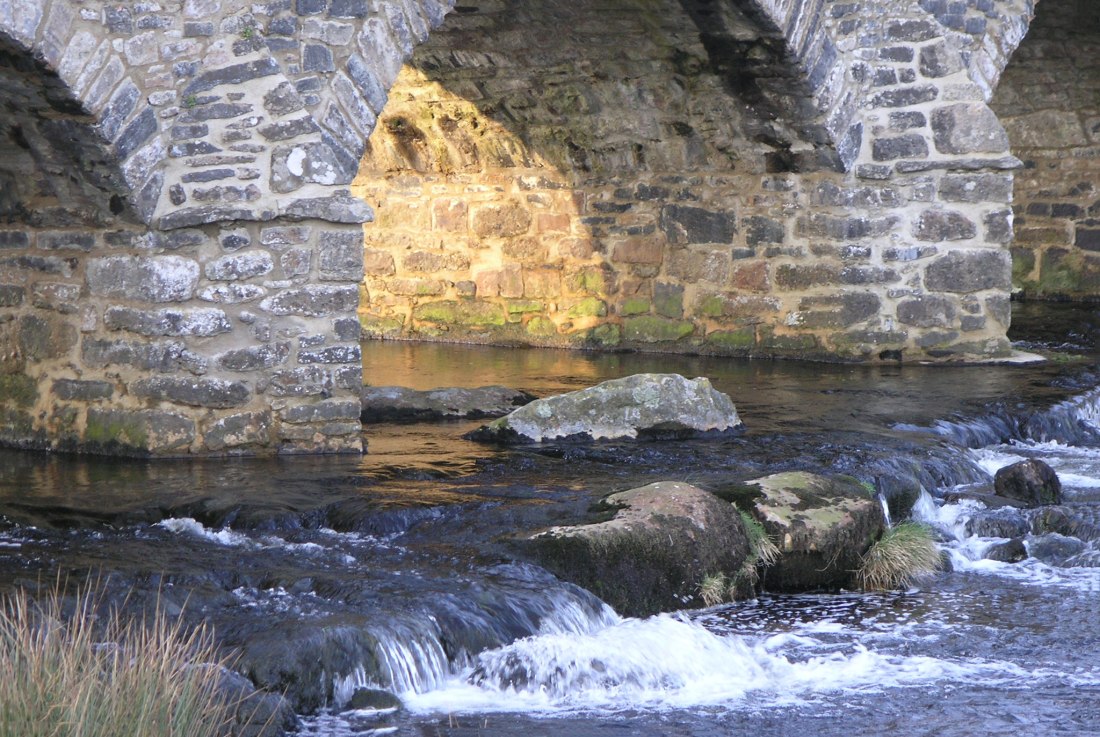
What am I photographing? Is it a famous Dartmoor bridge? Perhaps it’s the River Dart. Yes …. but… No. It’s the Sun.

“Eh?” I hear. “But the sun isn’t in the picture!”

Correct- but the Sun is too bright, too big, too awesome. No earth-bound camera can cope with that challenge. All we can do is record the effect of the Sun, showing how the light changes our perception of the world. Reflected by the stone and water inside the arch, light glows out. We just KNOW that if we looked through the arch, we’d see the sun (or be dazzled by it, anyway!).

When we say “What is God like?” we’re doing theology. Our problem is trying to explain and describe the gloriously indescribable- we lack the words to speak, and the mindpower to comprehend. Our best insight comes from the self-revelation of God’s true essence in the person of Jesus Christ. (Since it’s Lent, it is a great time to think about the life, death and resurrection of Jesus.)

Imagine describing an elephant to someone who has never seen one. Ask two friends to draw a picture, one starting from above, and the second person working from the feet upwards.

The picture might look like the one below: and it’s a brain teaser! How many legs does an elephant have? Of course you know… but the drawing may make you rather confused.

Now, the conclusion of Christian theologians is that Jesus is the Son of God, the second Person of the Holy Trinity, the Three-in-One. How will you explain the Trinity? Tricky… our best efforts are incomplete. How do you “explain” Jesus as both human and divine? With difficulty. If you start from the top, the God-ness of Jesus, you will understand quite a lot. If you start from below, the human-ness of Jesus you will understand a whole lot more.

But the picture isn’t perfect, or without mystery. It’s like the “legs of an elephant” picture… and it’s the best we can do. So if someone understands a bit differently, perhaps it’s just because they’re seeing from a different angle. We can still be friends, and still follow the path of Jesus.

Jesus said “I am the Light of the world.” All our theology, and all our debates, are trying to describe the effect of Light in a world in shadow. Our God is too big, too strong and too Mighty to capture in our “brain-cam.”

He is LIGHT. In a dark time in a suffering world, it’s the Light that keeps us alive, still hoping, still trusting, May the Light shine on you! 

River of Tears

Today – the 75th anniversary of the liberation of Auschwitz & Birkenau, the infamous Nazi death camps. It is Holocaust Memorial Day: and we should never forget. Words are inadequate but they are all I have. This is my Lament for the Jews, Gypsies, cast-outs, unwanted, despised… all the victims of what happens when evil thoughts are let loose.

MINOLTA DIGITAL CAMERA

Tears unheeded
shed on concrete floors
wiped away by skeletal kids
Lungs choked
by noxious hatred
with genocidal solutions

Lest we forget
Holocaustal reminders
should make us cry
so our generations
never repeat killing
by decree of expediency

Camps of Death
liberated by shocked soldiers
to save the few
Too late for millions
we must never forget
Auschwitz and Birkenau

Never again
for God’s sake
and ours

And theirs, hid in a river of tears.

(c) Richard Starling, Holocaust Memorial Day, 27th Jan 2020

Finding Wisdom on the Beach

It will be officially Spring on 1st March. Someone should let the weather know. We have snow forecast this week; a cold north-east wind is bringing Siberia to Sussex.

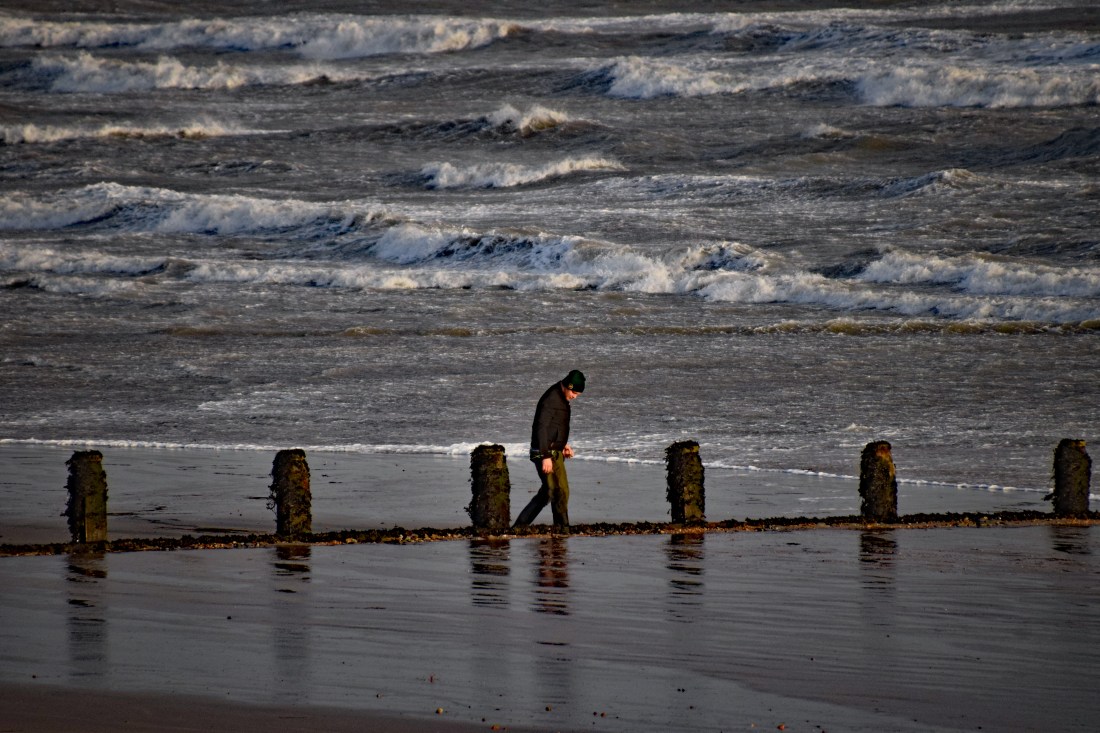
Despite the plunging temperatures, I am finding a benefit of living near the sea. It is a great place for wandering, pondering, and clearing the mind. I’m not the only one. This guy was walking towards the sunset as the tide pulled back. I’ll never know who he was. He was searching the sand and the breakwaters. I don’t know if he found anything, or even what he was looking for.

When I wander with my teeth chattering and my fingers freezing I find a sense of peace. Even when the ice or gales make for uncomfortable walking, the beach offers a myriad of interesting things. The tracks of seabirds, the colonies of shellfish, the patterns in the sand: the light picks out different features. Breaking waves and the sound of water retreating across the sands, with a chorus of gulls plaintively calling. Why do gulls sound so alone?  Sunset skies dye the wet sand in glorious technicolour. The Sun, the Moon, and sometimes the stars, shimmer their fractured reflections across the restless waters. It’s so beautiful. It has become a holy place for me.

Day or night, it helps me to sense the closeness of Almighty God: all this is His, and still He cares for His children. God makes Himself known in and through this world. People of faith have known this for centuries. The prophet Amos spoke of this: “It is the LORD who created the stars, the Pleiades and Orion. He turns darkness into morning and day into night. He draws up water from the oceans and pours it down as rain on the land. The LORD is his name!  Amos 5:8 (NLT)

I find myself taking opportunities to detour down to the beach. The long way home from the shops, the bank, our church. Ten minutes in the morning after dropping Juliet at school. An hour with the camera, looking for new ways to record the wisdom of God’s self-revelation in Creation. Time to reflect and pray for people and situations; time to filter out all the inner noise and confusions, the anger and irritations of an imperfect life.

Maybe tomorrow I will get to chase snowflakes into the sea. Perhaps the frost will laminate the pebbles. And just maybe, the quieting of my soul will allow the wisdom of God to touch my mind and change my heart. It is wise to search: to search is to find.

The Lord is His Name!