Frosted Clarity- Look, See, Pray

Frost has outlined these little beauties. Rims and veins have attracted icy crystals which accentuate the shapes and forms of flower, berry and leaf. It makes for a nice picture!

You may be surprised to know it can help us do theology too.

Theology is “God Knowledge/Thinking.” The information we have, the principles we hold to, and the interpretation of God’s revelation enable us to begin to comprehend God. We debate, discuss, argue, theorise, and write BIG books! (Wouldn’t it be helpful sometimes to have a simpler explanation, a short book or cartoon instead? If so, read on about the frosty rose!)

Christians have prepared summaries of what we believe: we call them Creeds. “I believe in God the Father…” is the beginning of the Apostles’ Creed (one of the mainstream standards). These Creeds have been agreed by many believers over many years, and are often familiar to most churchgoers.

Each Creed sets out statements of faith; the things we agree on as “standard” for Christianity. They set out a “map” of faith, rather like the frost on the rose petals. We see where each one fits, what’s “in” as a part of normal faith. (There are, of course, differences of emphasis and nuance between the churches! But bear with me on the main principle.)

We cannot fully comprehend God- but one central Christian belief is that God has been and is self-revealing. We can see the Divine in Creation itself- through beauty and awe. The Bible is a written collection of the history of God’s interaction with humanity, inspired by God and amazingly effective at teaching us about God and His Ways.

I suppose we could write different doctrines on every petal to make it even clearer. For example: the nature of God; Creation; Salvation; Bible; Ethics, etc., etc.

Theology is the whole rose- but the parts can be looked at separately. We can always discover and experience more of God; so our study is open-ended, and there are “mysteries” as well as plain and obvious truths. But even if the rose is a symbol for theology, God is above and beyond it- the Gardener who is greater than the rose (or the whole garden).

Do you get the idea? Just as the frost has highlighted nature’s beauty, so choosing particular aspects of faith to study helps to make sense of the bigger picture.

The best starting place?

The life, teaching, death and resurrection of Jesus. As set out in the four Gospels, Matthew, Mark, Luke, and John, we are introduced to the best self-revelation of God.

As Jesus said, “If you have seen me, you have seen the Father.” (John 14 v9)

Start here: GO.

Viennese Whirl? Look, See, Pray

The iconic Ferris Wheel in Vienna should have been demolished in 1916- but the Empire couldn’t afford it. Since then it has become a famous landmark, and appeared in the film “The Third Man” and also in a Bond film, “The Living Daylights.”

A local saying is that if you ride the wheel and see the whole of Vienna from there, you will love the city forever.

On our visit to Vienna, we didn’t have time to queue for tickets, so we only saw the Ferris Wheel from the tour bus. The effect worked at least partially- I’d love to go back and spend more time in Vienna- a city of beautiful architecture and great culture.

But apart from the classic engineering and the stunning view, the wheel has little value. It goes round, the cars rise, crest, and descend- and that’s it.

Is that how most of us see life? A treadmill with a good view?

Repetitive behaviour is part of life. We sleep, wake, eat, work, eat, and sleep. Assuming we are fortunate enough to get more than meal a day.

A Ferris wheel is essentially an entertainment. Life is a journey with purpose- or should be. Western society is in danger of being entertained to death! There must be more to life than this.

I am reminded of the experience of Zaccheus in Luke 19:1-10. He was a tax officer of dubious ethics- the basic way of tax collecting for the Roman provinces was to raise whatever the Governor told you to collect: and anything else you could extort was yours to keep. To say they were unpopular is a major understatement.

Yet Zaccheus realised his life was a failure. Having heard that Jesus was nearby, Zaccheus (a short bloke) climbed into a tree to listen. Imagine his shock when Jesus (against all custom and religious purity) invited himself to Zac’s place for a meal and chat! Everyone else was horrified- didn’t Jesus realise this was a SINNER, traitor, collaborator, tax collector!!!

Of course Jesus did. Upshot- Jesus was unpopular with the self-righteous snobs, Zac’s life was turned around, and the people who’d been ripped off were generously compensated. The Kingdom of God moved in, and turned the world upside down.

Jesus said that He was here to do what the Heavenly Father required. His call to Zaccheus (and us today) is to follow that way- to walk alongside Jesus, and do what God wants done.

It’s riskier, but it sure beats a Ferris wheel ride!

Becoming Aware- Look, See, Pray

Cooler moist air, early angled sunshine, and a spider’s web becomes an artwork: its fragility set off beautifully by the smooth solid rose-hips adding hints of colourful, warm, apricot.

Eureka! The kind of web that when not lit up can be walked into by us as well as bugs which then enlivens mornings with an impromptu outburst of spluttering interpretative dance.

Suddenly all the delicate structure of the engineering of a web is plain to see. How did spiders ever learn to do that?

The complexity of a garden eco-system is astonishing. So many creatures taking part in the interweaving dynamic of Life. Then the plants that provide beauty, food, cover and more. From ant to tree, there is a place for everything. Most of the events in our gardens happen without our awareness. Life and death conflicts go on in the grasses, the soil, and the air. Hidden birds burst into song (which we sometimes fail to notice- that is surely a crime!).

Becoming aware of the life around us is important. It sets us in the proper context as part of our home, our community, our world.

We will see, hear and smell things that lift our consciousness, and even open us on a spiritual level. Respect for creation often leads to a deeper respect, a reverence, towards God. Theologians talk about God being “immanent” – being present in and sustaining life- and this means God can be encountered in and through the stream of life we are part of. Grace roosts in our treetop, waiting to fly down to our shoulder.

As we step into our home, into our garden, onto our day’s journey, we are on holy ground. God is present, and through encountering His Presence we participate in holiness. We are “set aside” for a holy purpose which can be worked out wherever our day takes us.

My day started with a spider’s web. And I sensed the pleasure of Jesus as I photographed it, and as I started to write about the experience. God is here, as He always has been. Now, I am aware.

Psalm 113:4-6

The Lord is high above all nations;
His glory is above the heavens.
Who is like the Lord our God,
Who is enthroned on high,
Who humbles Himself to behold
The things that are in heaven and in the earth?

Beauty as a Key- Look, See, Pray.

Beauty in Nature is evident to most people, whether the colours of a flower or the song of a blackbird. A raspberry picked and eaten fresh is an exquisite experience; the gentleness of new beech leaves is like stroking satin. To be deprived of one or more of our five senses is rightly considered to be a great loss.

I have discovered that enjoying beauty in nature is a key that unlocks my spiritual senses. Finding the “fingerprint” of the Creator excites my spirit as well as emotions. So I use photography as a means to “record” God’s creative thought; it allows me to use Nature as a staircase to climb nearer to God.

Beauty is, for me at least, part of a three-pronged strategy for worshipping and knowing God. Becoming sensitive to the Presence and action of the Holy Spirit is the second “prong” – this is the hardest to explain as it is a “knowing” that is partly revelation of God and partly my attuned intuition. Third, but by no means least, is the role of Scripture. This is the written form of the Lord’s revealing grace through history, poetry, narrative, and prophecy- it is VITAL.

Bible “reading” by itself is good: then the effort that goes into truly comprehending the Books so they can inform and guide is considerable. Four years at Bible College was only the beginning of the beginning of me discovering Truth, paradox, mystery, and divine grace.

Learning to “do the Bible” is truly praiseworthy; the reading must affect our hearts as well as our mind. If not, we may become well-educated pieces of dead wood! Knowledge about God cannot take the place of KNOWING God.

Sometimes we struggle for closeness to God, and beat ourselves up about not reading the Bible enough (and/or not praying enough).

So if you find yourself “running rough” (or failing to connect through what we might call “religious acts”), try this approach route:

Go and FIND something absolutely BEAUTIFUL. Contemplate your “find” and ask questions of yourself (and of God).

1. Why does this move me?
2. How have I experienced God through beauty in the past?
3. What is it about this particular “beauty” that impacts my spirit?
4. Lord God, what are YOU saying to me in this?
5. Lord, please will you help me to draw closer through this beauty, and remind me of Scriptures that speak further of Your Love; then allow Your Spirit to breathe life, fire or living water in to my soul.

By the way, aren’t Foxgloves pretty?
Enjoy the photo- and seek Jesus through it!

Forgive? Look, See, Pray

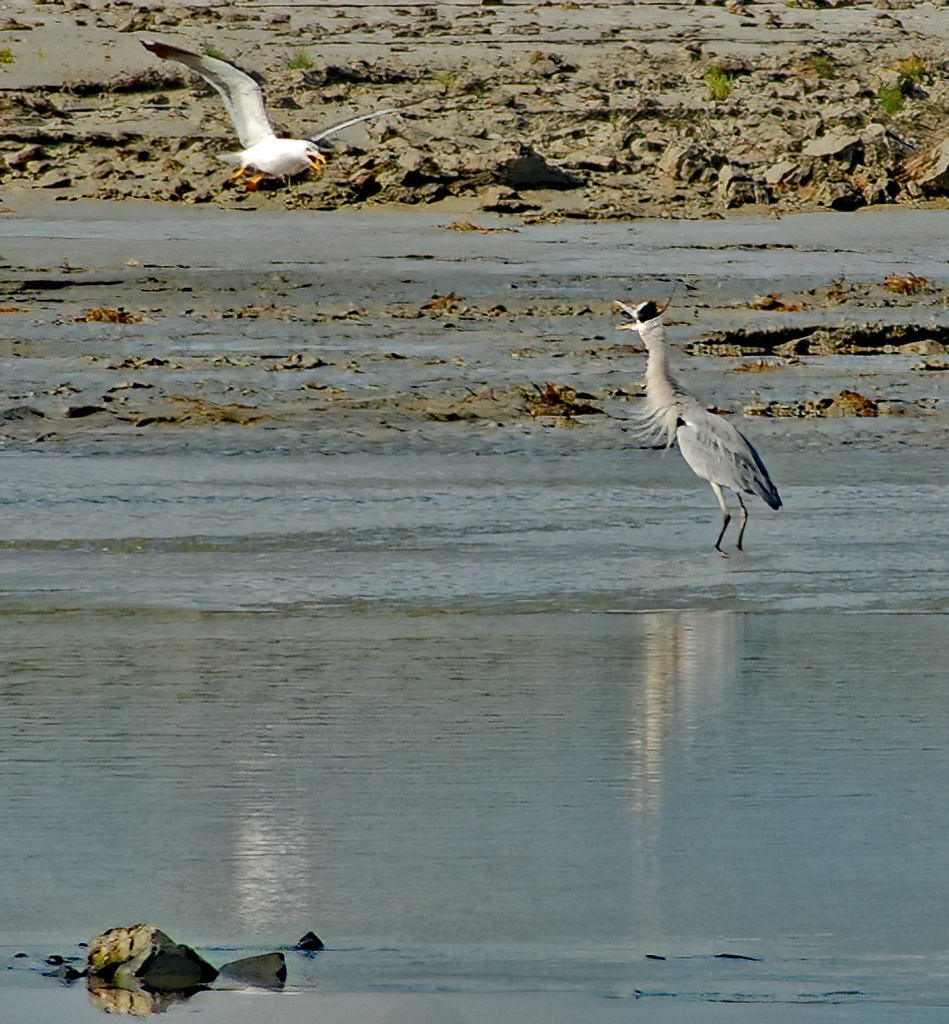
This is a photo that surprised me… I was taking pictures at Mont St Michel, and concentrating on the low-tide water across the sands. Nice colours and reflections. I saw the heron and some gulls and used them in the composition, as one might!

When checking the photos later, I realised there was a squabble going on between the angry heron and one bolshie gull. Beaks agape, they were swearing at each other (presumably in French) and generally being disagreeable.

Then this evening I was reading an article by Dr RT Kendall about forgiveness- especially if the other party isn’t sorry or repentant or forgiving.

Isn’t it hard to forgive when the opponent is being a ***** (insert rude word of your choice) and slapping them seems appealing?

Unless you are super-human, the answer is YES. It’s very hard.

But then Jesus never said following Him would be easy. Jesus under incredible pain and pressure on the Cross cried out “Father, forgive them for they don’t know what they are doing!” (Luke 23:34)

Not long after the Resurrection & Pentecost, the first Christian martyr was killed: in Acts 7 :59-60 we read-
“While they were stoning him, Stephen prayed, “Lord Jesus, receive my spirit.” Then he fell on his knees and cried out, “Lord, do not hold this sin against them.” When he had said this, he fell into the sleep of death.

Whether the issue is about fishing rights like the gull and heron, or a deathbed act of forgiveness like Jesus and Stephen, the question of forgiveness is very real.

The Lord’s Prayer contains this statement: “Lord forgive us our trespasses AS WE FORGIVE those who trespass against us.” (see Matthew 6 v12-14). So, if we will not forgive… can we be sure God will forgive us?

That’s a big complex question, too big for a short post. What do you think?

Certainly, if we refuse to forgive another, WE will be the one hurt most… we injure ourself. Is the satisfaction of demanding an apology greater than the life-enhancing joy that comes from true forgiveness? Is there any act we can do that is more Jesus-like than to forgive?

Politics… and faith. Look, See, Pray.

It’s Polling Day in the USA: and there is justifiable concern about the outcome in a very polarised, deeply divided electorate. Probably half of the electorate will be upset/furious whatever the result. The result will have consequences, at this stage not entirely predictable.

Most of us will have opinions about one or both candidates: and though the best choice seems blindingly obvious to me, there will be sincere voters who won’t agree!

I don’t have a vote, anyway.

My hope and trust is in God, the Eternal Three in One, whose Will shall ultimately be done (however this election and the current world political brouhaha turns out).

As Jesus taught us to pray, “May Your Will be done on earth as it is in heaven.” Alongside that prayer, I’ve chosen a photo that displays something of the wonder of this world: bright scarlet autumn rose-hips with a small Shield Bug crawling after food or shelter. Even as winter draws on, life continues with flora and fauna blissfully innocent of human politics. Although vulnerable to change and “chance,” this world- so far- has a good record of surviving human dramas (though we seem to be trying to spoil that record through greed and injustice!).

The Sun will rise in the morning. It will set tomorrow evening. And the American election result will NOT have shaken Heaven’s foundations, nor given God a horrible surprise. All things are ultimately in the Best Hands… the hands that were marred by nails on the Cross. That was a dreadful Day: and it was followed by Resurrection. Life finds a Way.

So, Father God- as for me and my house, we will serve the Lord Jesus every day. Please grant us peace and faith, even in our fears and the uncertainties we face. Keep pouring out Holy Spirit truth and compassion. Have mercy on Your troubled world- which we have diminished and defaced. May Your Will be done on earth as it is in heaven. May Your Kingdom come! Come soon, Lord Jesus, and rule as King of Kings and Master of Presidents and politicians. Amen.

Splintered Light- Look, See, Pray

“Stand with the Sun behind you and you’ll get a nice photograph.” Safe advice, often given to new photographers… I think that film manufacturers wrote something similar in with the rolls of film (I’m assuming some of you remember “film” for prints or slides). It was not cheap, and developing costs for prints were quite high. In the Era B.D. (Before Digital) poor hobbyists had to work hard, and not take too many chances. Playing safe saved money! Quite often the results were predictable, and frankly often boring.

Taking a photo like the one above was a big “no-no”. Risky! Measuring the light (or guessing the exposure) was an arcane exercise. Although, from the 1970s onwards technology was progressing and in-camera light meters reduced the odds of failure.

Experience gained (often from making mistakes) helped; and whole books were penned about “correct exposure” and effective composition. A steep learning curve and an expensive hobby!

Today’s photo is of frosted grasses and weeds, just beginning to thaw in early morning sunshine. The sunlight was at 450 towards the lens, backlighting the droplets and splintering the light. I used a low crouching position to shield the lens from direct sunlight, preventing flare and sunspots. Clever stuff! (I won’t spoil the effect by telling you how many other attempts of scenes like this were failures.)

Taking risks and seeking out “learning moments” will shape us into better photographers. Capturing light and interpreting it is the very heart of photography. Funnily enough, the principle is very similar to good theology! Looking at the Light of revelation, and trying understand and apply it to life- what we know about God, and what difference it makes.

We can “play safe” with faith, carefully colouring in between the lines and avoiding tricky questions. Predictable, satisfying, unobjectionable. We can learn “our” party line, listen to “safe” speakers, and hide safely in the crowd. For a while at least, that can be good enough.

But when BIG questions come up, when tragedy rocks our foundations, when moral and theological issues impact “our” small world, we have to go looking for insights from a fresh angle. We look into the Light, squinting and blinking, and discover that splintered Light illuminates in a newly beautiful way. In taking a risk, we are stretching out in our faith- and always seeking to draw closer to God Himself. The essential “Good News” (the Light itself) is unchanged; but moving our viewpoint helps us see MORE.

Perhaps learning more about the Bible itself from scholars and mature believers; or opening ourselves to “Go on going on being filled with the Spirit” (Ephesians 5 v18). The great Reformers and Puritans had a saying “The Lord has yet more Light to break forth from His Word.” When we stop learning, we stop growing.

Jesus took his Twelve disciples on a three-year journey of discovery. They learned about God, about the Scriptures, about themselves- and a whole load of experiences and puzzles that stretched their minds and spirits until they became more and more like Jesus. They took risks, faced impossible odds, saw God at work in unthinkable ways: they wept at the crucifixion and were astounded at Resurrection. They then received the Holy Spirit at Pentecost… and their story journeys through the centuries to join our own.

Faith and photography are simply “learning to see Light.” Then the Light reveals Life, and drives out the darkness. “Faith” and “photo” can both be spelled R-I-S-K.

(c) 2024, Richard Starling. First posted on reflectionary.org on this date.

Outcast- Look, See, Pray

As a young-ish fella my pastor set me a challenge. “I’m preaching about Moses next week. How about writing a song for me?” The folk/gospel revolution of the 70s, a fingerpickin’ guitarist, and a week… Challenge accepted!

Why a wild flower photo? I came across it in the wild flower bed I set up this spring- I’ve never seen one before, it may have been in the seed mix- or a gift from a passing bird. A lone outcast surviving in the wilds. So it seemed appropriate. Anyway, here’s the lyric for “Outcast.”

Sheep are my business, the desert my home
since running from Egypt and dead men's bones.
My people are distant, far from this place-
a moment of passion cuts me off from my race.
The years have crawled onwards, the people are slaves.
The Chosen of Yahweh fall into their graves.
So now I just wander on lonely sand
sing to my sheep and clasp empty hands.

To wander forever could well be my fate
since running away from a murderer's hate.
A passion for justice, desire to be free,
to count Israel's children as sand by the sea.
But now I'm an outcast, my timing was wrong.
But the children of Yahweh have suffered so long.
They need a new leader with vigour and fire,
to seek after Yahweh and draw people higher.

But what do I see? The bush is on fire!
Yet nothing is burning, my soul is inspired.
Sand on my bare feet, I'm on holy ground
and Yahweh is speaking to the leader He's found.

He called me and chose me, although I fought shy,
Ran out of excuses- and oh, how I tried!
So now I will travel to Pharoah's land
release Yahweh's people from Death's clinging hand.

But what do I see? The bush is on fire!
Yet nothing is burning, my soul is inspired.
Sand on my bare feet, I'm on holy ground
and Yahweh is speaking to the leader He's found.
Yes, Yahweh is speaking to the leader He's found.


(c) Richard Starling, 1978

Why “Art”? Look, See, Pray

Some pictures move me on a mental, emotional and spiritual level. Wondering why this is so, I looked up a definition of art and found several. Like this one:

“Art is an expression of yourself, so create a mood with your description. Describe it as if the person were in pitch black and could not see it. Think about the feeling you want to express through your piece. What did you feel when you made this?”

I was experimenting with some old photos, and found some of Pagham Harbour nature reserve. The original photo was a bit dull- the ground was dark and featureless, the sky rather bland. A bit of tweaking made it better. Then I applied a “texture” filter, and suddenly the picture spoke. It became like an oils-on-canvas painting, and came alive.

What did I feel when I made this? Excellent question! It made me remember what I felt when I took the photograph. Quietness is a feature of the Reserve. The most noticeable noises are natural ones; the sound of waterfowl, the gentle lapping of the water. Cool gentle air moved enough to make me shiver. Curlews whistled nearby, and that always sounds mournful- or perhaps “plaintive” is the word I’m looking for.

Natural sounds too often get masked by “progress.” Engines, planes, radios, shouting and bustle. It’s almost as though we are afraid of silence, of any quietness, so that we have to go looking for it and leave our civilised mod-cons behind.

Why do I love the open air so much? Because I can slow down and listen, look round and take in the “art” that God made. It is a meeting-place free of distractions. An art gallery of beauty signed with the Creator’s mark- and He said of the world “It is good.”

I can’t know YOUR reaction to this picture. Does it make you feel something, make you take a second look? ! wonder… (Try opening the photo to full screen for more impact.)

God is present at all times and places… our problem is one of being un-receptive, or impatient, or preoccupied. We need to find the art, the places, and the open heart that allows us to encounter Love. After all, God has said that we WILL find Him, when we seek with all our heart…

Shared Wisdom- Look, See, Pray

Seeking wisdom in the Tree Cathedral, near Whipsnade.

The Tree Cathedral is a wonderful place to visit, pray, and think. I used to live fairly close, and always found it a sympathetic destination! When there, I could walk among the trees and it seemed as if God were easier to reach. Did you know that trees are mentioned in the Bible more than any living thing other than God and people? There’s a tree on the first page of Genesis, the first Psalm, the first page of the New Testament, and the last page of Revelation. 

In the Wisdom literature of the Old Testament, a collection of proverbs describe wisdom as a character, as if wisdom is really a person rather just “knowing stuff.” Encyclopaedias are stuffed with facts, but until facts are learned and put into practice the book isn’t much use to anyone.

“Wisdom is a tree of life to those who take hold of her; those who hold her fast will be blessed” Proverbs 3:18

“Do you lack wisdom? Ask for it!” said James (see James 1 v5). If our natural inclination is to “go it alone” there is no-one to check with- “Am I right or wrong?” Gaining wisdom is best done as a shared quest, life done as a rhythm of personal thinking and shared conversation. Part of my calling as a pastor and theologian has been to explore, learn, and develop in both knowledge and wisdom: and it has always been a journey with companions (and done in the context of including God and the scriptures along the way).

Then my vocation is to share what I have discovered, and try to do so in words that make things clearer and easier to grasp for other people.

This morning I came across a blog post that succeeds in that aim: so I’m sharing a snippet of wisdom! Question: how well do you understand the Holy Trinity? “Father, Son and Holy Spirit” is the form of words we use to describe God. But what does that mean?

Mike Higton, theologian at the University of Durham, set himself the challenge of explaining the Holy Trinity in words of one syllable:

“So there is God, the one to whom we pray, the one to whom we look, to whom we call out, the one who made the world and who loves all that has been made. And then there is God by our side, God once more the one with whom we pray; God in the life of this man who shares our life, this man who lives the life of God by our side, and who pours out his life in love for us. And then there is God in our hearts, God in our guts, God one more time, the stream in which we dip our toes, the stream in which we long to swim, the stream which filled the Son and can fill us too, and bear us in love back to our source.

Link to the full blog post: click here: The Trinity explained in words of one syllable | Psephizo

God: the to whom, and with whom, who is also within. You may or may not feel qualified to write a book of theology now, but I suspect you have a better appreciation of the Holy Trinity- and you have gained wisdom as a result. Wisdom shared by Mike Higton, me, and now you. And next time someone asks us “What about the Trinity, then?” we may feel wise enough to pass on what we have discovered.

Wisdom is for sharing! Here’s a prayer you may like to use:

O Lord our God,
help us to know you when we pray.
Help us to know you as the one to whom we pray;
help us to know you as the one with whom we pray;
help us to know you as the one in whom we pray.
Help us to know you, and to love you,
and to live our lives for you,
one God in three,
Holy Trinity. Amen.